MCQ
All element in $3$$^{rd}$ period have
  • A
    An atomic number $3$
  • B
    $3$ complete sub-shells
  • Valence electrons shell
  • D
    $3$ electrons less than the octet

Answer

Correct option: C.
Valence electrons shell
c
All elements in $3^{rd}$ period have $3$ completely filled subshells (i.e $1 s , 2 s$ and $2 p$ )

Need a full question paper?

Generate a complete, print-ready paper with questions like this in minutes — across 16+ boards, with answer keys.

Start Generating Free

Similar questions

What will be the $IUPAC$ name of the given compound

$\begin{array}{*{20}{c}}
  {\,\,\,\,\,\,\,\,\,\,\,\,\,\,\,\,\,\,\,\,\,\,\,\,\,\,\,\,\,\,\,\,\,C{H_3}\,\,\,\,\,\,\,\,\,\,\,\,\,\,\,\,\,\,\,\,C{H_2} - C{H_3}} \\ 
  {\,\,\,\,\,\,\,\,\,\,\,\,\,\,\,\,|\,\,\,\,\,\,\,\,\,\,\,\,\,\,\,\,\,\,\,\,\,\,\,\,\,\,\,\,\,\,\,\,|} \\ 
  {C{H_3} - CH - CH - C{H_2} - CH - C{H_3}} \\ 
  {|\,\,\,\,\,\,\,\,\,\,\,\,\,\,\,\,\,\,\,\,\,\,\,\,\,\,\,\,\,\,\,\,\,\,\,\,\,\,\,\,\,\,\,\,\,\,\,\,} \\ 
  {C{H_2} - C{H_{3\,\,\,\,}}\,\,\,\,\,\,\,\,\,\,\,\,\,\,\,\,\,\,\,\,\,\,\,\,} 
\end{array}$
Which of the following order is correct
$N_2O_5$ decomposes to $NO_2$ and $O_2$ and follows first order kinetics . After $50\, minutes$, the pressure inside the vessel increases from $50\, mm\,Hg$ to $87 .5\, mm \,Hg$. The pressure of the gaseous mixture after $100\, minutes$ at constant temperature will be ........... $mm\,Hg$
$A = 1s^2\, 2s^2\, 2p^4$         $B = 1s^2\, 2s^2\, 2p^5$       $C = 1s^2\, 2s^2\, 2p^6$
$A, B$ and $C$ are atoms/anion of same element. Then which one is correct (One of $A/B/C$ is neutral atom)
Which one of the following is the correct statement? As azeotropic solution of two liquids  has a boiling point higher than both of them, then it :-
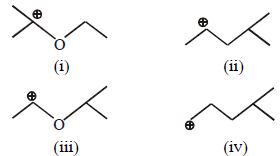
Correct order of stability for following carbocations
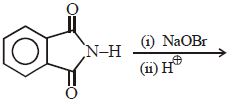
Product of reaction is 
An organic compound $(A)$ (molecular formula $\left. C _{6} H _{12} O _{2}\right)$ was hydrolysed with dil. $H _{2} SO _{4}$ to give a carboxylic acid $(B)$ and an alcohol $(C).$ $'C'$ give white turbidity immediately when treated with anhydrous $ZnCl _{2}$ and conc. $HCl$. The organic compound $(A)$ is 
The conjugate base of hydrazoic acid is
The compound which does not possess a peroxide linkage is