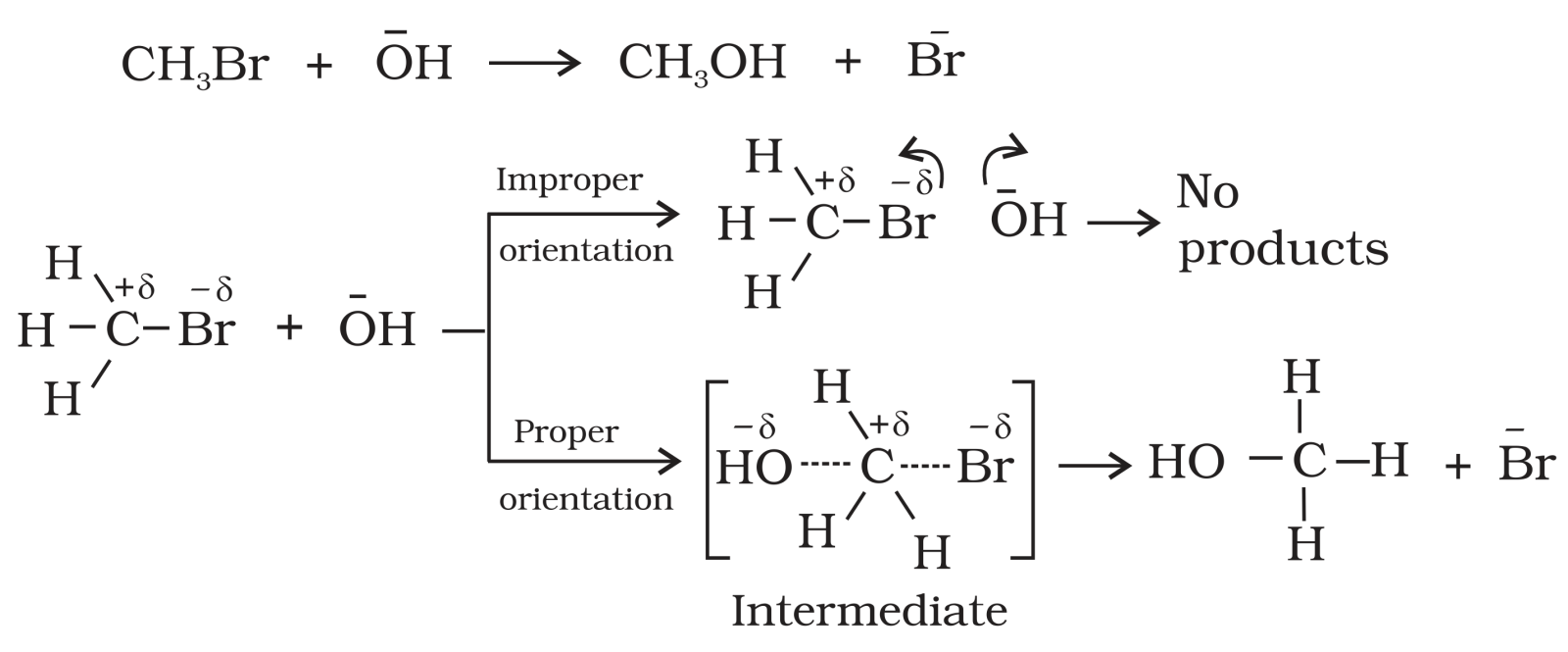
Question
All energetically effective collisions do not result in a chemical change. Explain with the help of an example.

Need a full question paper?

Generate a complete, print-ready paper with questions like this in minutes — across 16+ boards, with answer keys.

Start Generating Free

Similar questions

Which forces are responsible for the stability of $\alpha-\text{helix}?$ Why is it named as 3.613 helix?
Specify the oxidation numbers of the metals in the following coordination entities:
i. $\left[ Co \left( H _2 O \right)( CN )( en )_2\right]^{2+}$
ii. $\left[ Pt ( Cl )_4\right]^{2-}$
iii. $K _3\left[ Fe ( CN )_6\right]$
iv. $\left[ Cr \left( NH _3\right)_3 Cl _3\right]$
Write the IUPAC names of the following coordination compounds:
i. $\left[ Co \left( NH _3\right) 6\right] Cl _3$
ii. $\left[ Co \left( NH _3\right)_5 Cl \right] Cl _2$
iii. $K_3\left[ Fe ( CN )_6\right]$
iv. $K_3\left[ Fe \left( C _2 O _4\right)_3\right]$
v. $K_2\left[P_{d C l}^4\right]$
vi. $\left[ Pt \left( NH _3\right)_2 Cl \left( NH _2 CH _3\right)\right] Cl$
The rate constant for the first order decomposition of H2O2 is given by the following euqation :
$\log k=14.34-1.25 \times 10^4 K / T$
Calculate $E_{a}$ for this reaction and at what temperature will its half-period be 256 minutes?
  1. Account for the following:
  1. Transition metals show variable oxidation states.
  2. Zn, Cd and Hg are soft metals.
  3. Evalue for the Mn3+/Mn2+ couple is highly

positive (+ 1·57 V) as compared to Cr3+/Cr2+.

  1. Write one similarity and one difference between the chemistry of lanthanoid and actinoid elements.
Derive a formula to determine the molar mass of a solute by depression of freezing point.
Mention the IUPAC rule used to write the formulas of mononuclear coordination compounds.
CoSO4Cl.5NH3 exists in two isomeric forms ‘A’ and ‘B’. Isomer ‘A’ reacts with AgNO3 to give white precipitate, but does not react with BaCl2. Isomer ‘B’ gives white precipitate with BaCl2 but does not react with AgNO3. Answer the following questions.
  1. Identify ‘A’ and ‘B’ and write their structural formulas.
  2. Name the type of isomerism involved.
  3. Give the IUPAC name of ‘A’ and ‘B’.
Using IUPAC norms write the formulas for the following:
a. Tetrahydroxozincate(II)
b. Potassium tetrachloridopalladate(II)
c. Diamminedichloridoplatinum(II)
d. Potassium tetracyanonickelate(II)
e. Pentaamminenitrito-O-cobalt(III)
f. Hexaamminecobalt (III) sulphate
g. Potassium tri(oxalato) chromate(III)
h. Hexaammineplatinum(IV)
i. Tetrabromidocuprate(II)
j. Pentaamminenitrito-N-cobalt(III)
For the decomposition of azoisopropane to hexane and nitrogen at 543 K , the following data is obtained :
$t( sec )$$P$ (mm of Hg )
035.0
36054.0
72063.0

Calculate the rate constant.