MCQ
All the elements in a group in the periodic table have the same
  • A
    Atomic number
  • B
    Electronic configuration
  • C
    Atomic weight
  • Number of electrons in the outermost shell or number of electrons for bonding

Answer

Correct option: D.
Number of electrons in the outermost shell or number of electrons for bonding
d
Modern periodic table is compiled on the basis of atomic number of element. Hence, elements of each group or family have same number of electrons in their outermost or valence shell.

Need a full question paper?

Generate a complete, print-ready paper with questions like this in minutes — across 16+ boards, with answer keys.

Start Generating Free

Similar questions

Which of the following does not have a coordinate bond
The Birch reduction of benzoic acid gives
Which of the following is $NOT$ tetrahedral in shape?
Amongst $LiCl, BeCl_2, MgCl_2$ and $RbCl$ the compounds with greatest and  least ionic character, respectively are
Product $(Z)$ is
Assertion : Buffer system of carbonic acid and sodium bicarbonate is used for the precipitation of hydroxides of third group elements.
Reason : It maintains the $pH$ to a constant value, about $7.4.$
Which element has the lowest electronegativity
The correct statement regarding nucleophilic substitution reaction in a chiral alkyl halide is ;
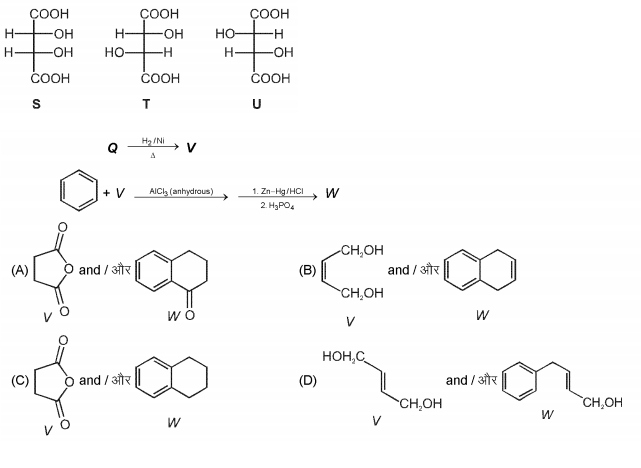
$P$ and $Q$ are isomers of dicarboxylic acid $C _4 H _4 O _4$. Both decolorize $Br _2 / H _2 O$. On heating, $P$ forms the cyclic anhydride.

Upon treatment with dilute alkaline $KMnO _4, P$ as well as $Q$ could produce one or more than one from $S , T$ and $U$.$Image$

$1.$ Compounds formed form $P$ and $Q$ are, respectively

$(A)$ Optically active $S$ and optically active pair $(T, U)$

$(B)$ Optically inactive $S$ and optically inactive pair $(T, U)$

$(C)$ Optically active pair $(T, U)$ and optically active $S$

$(D)$ Optically inactive pair $(T, U)$ and optically inactive $S$

$2.$ In the following reaction sequences $V$ and $W$ are respectively :$Image$

mcq $Image$

Give the answer question $1$ and $2.$
The solubility product of $AgI$ at $25\,^oC$ is $1.0 \times {10^{ - 16}}\,mo{l^2}\,{L^{ - 2}}$. The solubility if $AgI$ in ${10^{ - 4}}\,N$ solution of $KI$ at $25\,^oC$ is approximately (in $mol$ ${l^{ - 1}})$