MCQ
All the five digits numbers in which each successive digit exceeds its predecessor are arranged in the increasing order of their magnitude. The $97^{th}$ number in the list does not contain the digit:
  • A
    $4$
  • $5$
  • C
    $7$
  • D
    $8$

Answer

Correct option: B.
$5$
b
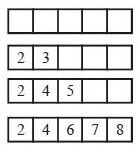
All the possible number are $^{9} \mathrm{C}_{5}$ (none containing the digit $0$ $)=126$

Total numbers starting with

$1 = {\,^8}{{\rm{C}}_4} = 70$

${ \text { (using }2,3,4,5,6,7,8,9)} $

${\text { Total starting with }}$

$\qquad 23 = {\,^6}{{\rm{C}}_3} = 20$

$(\text { using } 4,5,6,7,8,9)$

${\text { Total numbers starting with }} $

$\qquad 245 = {\,^4}{{\rm{C}}_2} = 6$

${\rm{ 9}}{{\rm{7}}^{th}}{\rm{  number }} = $
Need a full question paper?

Generate a complete, print-ready paper with questions like this in minutes — across 16+ boards, with answer keys.

Start Generating Free

Similar questions

If $x = cy + bz,\,\,y = az + cx,\,\,z = bx + ay$ (where $x, y, z $ are not all zero) have a solution other than $x = 0$, $y = 0$, $z = 0$ then $a, b$  and $ c $ are connected by the relation
$\lim _{x \rightarrow \infty} \frac{(\sqrt{3 x+1}+\sqrt{3 x-1})^6+(\sqrt{3 x+1}-\sqrt{3 x-1})^6}{\left(x+\sqrt{x^2-1}\right)^6+\left(x-\sqrt{x^2-1}\right)^6} x^3$
The locus of a point which moves in such a way that its distance from $(0,0)$ is three times its distance from the $x$-axis, as given by
Any circle through the point of intersection of the lines $x + \sqrt 3 y = 1$ and $\sqrt 3 x - y = 2 $ if intersects these lines at points $P$ and $Q$, then the angle subtended by the arc $PQ$ at its centre is ............ $^o$
Find area of the triangle with vertices at the point given in each of the following: $(-2,-3),(3,2),(-1,-8)$
The degree of differential equation 

${\left( {\frac{{{d^3}y}}{{d{x^3}}}} \right)^2} + 4{\left( {\frac{{dy}}{{dx}}} \right)^3} = 3\sin \left( {\frac{{{d^2}y}}{{d{x^2}}}} \right)\,is - $

Let $y=y(x)$ be the solution of the differential equation $ \cos x(3 \sin x+\cos x+3) d y= (1+y \sin x(3 \sin x+\cos x+3)) d x  ; 0 \leq x \leq \frac{\pi}{2}, y(0)=0 .$ Then $, y\left(\frac{\pi}{3}\right)$ is equal to $.........$
The co-ordinates of points $A,B,C,D$ are $(a, 2, 1), (1, -1, 1), (2, -3, 4)$ and $(a+1, a+2, a+3)$ respectively. If $AB = 5$ and $CD = 6$, then $a = $
The points of intersection of the curves whose parametric equations are $x = {t^2} + 1,\;y = 2t$ and $x = 2s,\;y = \frac{2}{s}$ is given by
If graph of $y = ax^2 + bx + c$ as follows

$\Delta ABC$ is right angled osceles triangle with hypotenuse $AC = 4\sqrt 2\ units$ then minimum value of $ax^2 + bx + c$ is