MCQ
All viruses contain:
- AProtein coat
- BCell membrane
- CEndoplasmic Reticulum
- DMitochondrial DNA
Explanation:
Viruses are intracellular obligatory parasitic, self - replicating non - cellular, sub - microscopic organisms.
They lack cellular organelles like ribosomes, mitochondria, etc.
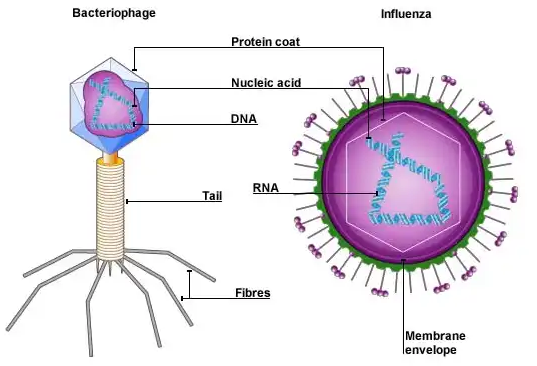
A simple virus particle, often called as a virion, consists of a nucleic acid core of genetic material, enclosed within a protein coat (capsid).
The capsid consists of several identical protein subunits known as capsomeres.
The amount of protein content differs in different types of viruses.
Generate a complete, print-ready paper with questions like this in minutes — across 16+ boards, with answer keys.
$I.$ Insulin $II.$ Epinephrine $III.$ Oestradiol $IV.$ Norepinephrine $V$. Testosterone $VI$. Glucagon
|
Column $I$ $(Function)$ |
Column $II$ $(Part of Excretory System)$ |
|
$(a)$ Ultrafiltration |
$(i)$ Henle’s loop |
|
$(b)$ Concentration of urine |
$(ii)$ Ureter |
|
$(c)$ Transport of urine |
$(iii)$ Urinary bladder |
|
$(d)$Storage of urine |
$(iv)$ Malpighian corpuscle |
|
|
$(v)$Proximal convoluted tubule |