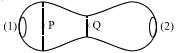
Ametallic conductor of irregular cross-section is as shown in the figure. Aconstant potential difference is applied across the ends $(1)$ and $(2)$. Then :
Diffcult
Download our app for free and get started
$(A) I_{P}=I_{Q}$
$(B) J=\sigma E$
$J_{P} < J_{Q}$
$E p < E_{Q}$
$(C)$ $H=I^{2} R \& R \propto \frac{1}{A}$
$R_{P} < R_{Q}$
$H_{P} < H_{Q}$

Download our appand get started for free
Experience the future of education. Simply download our apps or reach out to us for more information. Let's shape the future of learning together!No signup needed.*
Similar Questions
- 1A cell of $emf\;4\,V$ and internal resistance $0.5\,\Omega$ is connected to a $7.5\,\Omega$ external resistance. The terminal potential difference of the cell is $.....\,V$.View Solution
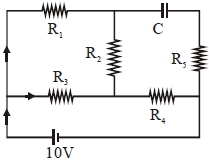
- 2An ideal cell of emf $10\, V$ is connected in circuit shown in figure. Each resistance is $2\, \Omega .$ The potential difference (in $V$) across the capacitor when it is fully charged isView Solution
- 3Two identical heaters rated $220\, volt$, $1000\, watt$ are placed in series with each other across $220 \,volt$ lines. If resistance do not change with temperature, then the combined power is ............. $watt$View Solution
- 4View SolutionAssertion : The electric bulbs glows immediately when switch is on.
Reason : The drift velocity of electrons in a metallic wire is very high.
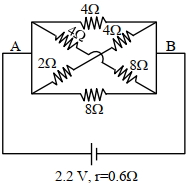
- 5In the given figure, the $emf$ of the cell is $2.2\, {V}$ and if internal resistance is $0.6\, \Omega$. Calculate the power dissipated in the whole circuit: (in $W$)View Solution
- 6A wire of $1 \,\Omega$ has a length of $1\, m$. It is stetched till its length increases by $25\, \%$. The percentage change in resistance to the neartest integer is .....$\%$View Solution
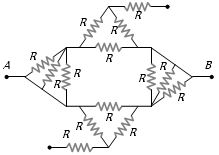
- 7Find equivalent resistance between $A$ and $B$View Solution
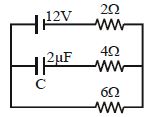
- 8Charge on the capacitor in the given circuit in steady state condition is :- ............... $\mu C$View Solution
- 9Voltmeters $V_1$ and $V_2$ are connected in series across a $D.C.$ line. $V_1$ reads $80\, volts$ and has a per volt resistance of $200 \,\Omega$. $V_2$ has a total resistance of $32 \,kilo-ohms$. The line voltage is .............View Solution
- 10A cell of internal resistance $r$ is connected across an external resistance $n r$. Then the ratio of the terminal voltage to the emf of the cell isView Solution