Question
Among identical spheres A and B having charges −15C and −16C:

Answer

  1. −15C is at higher potential.
Explanation:
Potential at surface of a sphere of radius r is V = kQ/ r
As identical sphere so r is same for both, Thus V will depend on charge Q.
So when Q is more, potential will be more.
Since −15 C is more than −16 C, so −15 C sphere will have higher potential.

Need a full question paper?

Generate a complete, print-ready paper with questions like this in minutes — across 16+ boards, with answer keys.
Start Generating Free

Similar questions

How much water should be filled in a container $21 \ cm$ in height, so that it appears half filled when viewed from the top of the container $($given that $\mathrm{a}^{\mu_\omega} = 4/3)$
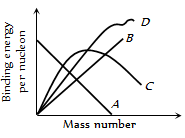
Binding energy per nucleon plot against the mass number for stable nuclei is shown in the figure. Which curve is correct
Alternative current generator is basically based upon:
Hydrogen $(H),$ deuterium $(D),$ singly ionized helium $\left(\mathrm{He}^{+}\right)$ and doubly ionized lithium $(Li)$ all have one electron around the nucleus. Consider $n =2$ to $n = 1$ transition. The wavelengths of emitted radiations are $\lambda_1, \lambda_2, \lambda_3$ and$ \lambda_4$  respectively. Then approximately
A ray is reflected in turn by three plain mirrors mutually at right angles to each other. The angle between the incident and the reflected rays is (a) 90°(b) 60°(c) 180°   (d) None of these
       
Surface temperature of the sun is of the order of(a) 5000 K(b) 7000 K(c) 6000 K(d) 12000 K
       
Which of the following statement is not correct about two parallel conductors carrying equal currents in the same direction?
The periodic time of rotation of a certain star is $22$ days and its radius is $7 \times 10^8$ metres. If the wavelength of light emitted by its surface be $4320 \mathring A ,$ the Doppler shift will be $(1$ day$ = 86400  \sec)$
The figure shows a process on a gas in which pressure and volume both change. The molar heat capacity for this process is $C.$
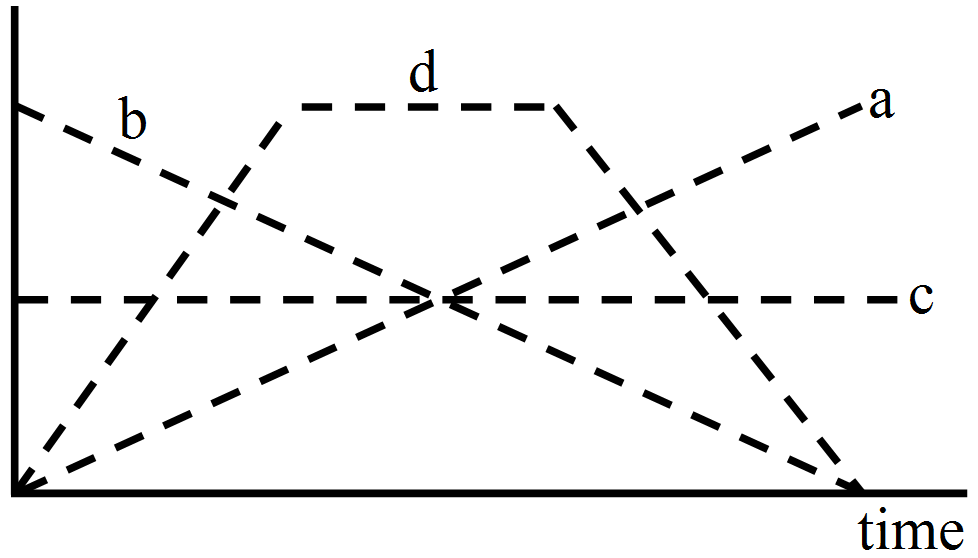
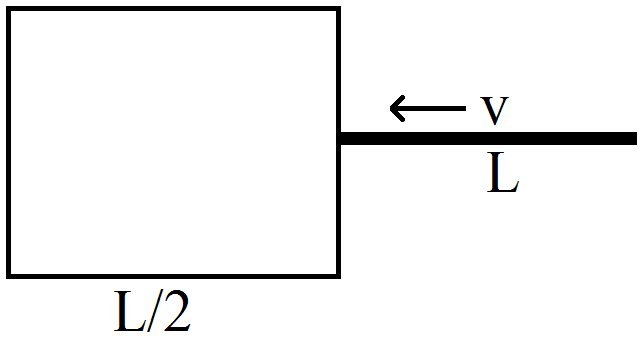
Figure shows an imaginary cube of edge $\frac{\text{L}}{2}.$ A uniformly charged rod of length L moves towards left at a small but constant speed u. At t = 0, the left end just touches the centre of the face of the cube opposite it. Which of the graphs shown in figure represents the flux of the electric field through the cube as the rod goes through it?

  1. a
  2. b
  3. c
  4. d