MCQ
Among the alkali metals $Cs$ is the most reactive because :
  • its incomplete shell is nearest to the nucleus
  • B
    it has a single electron in the valence shell
  • C
    it is the heaviest alkali metal
  • D
    its outermost electron is more loosely bound than the outermost electron ofthe other alkali metals

Answer

Correct option: A.
its incomplete shell is nearest to the nucleus
Among the alkali metals, $Cs$ is the most reactive because its outermost electron is more loosely bound than the outermost electron of the other alkali metals. This is due to the increase in distance between the outermost electron shell and the nucleus.

Need a full question paper?

Generate a complete, print-ready paper with questions like this in minutes — across 16+ boards, with answer keys.

Start Generating Free

Similar questions

Which of the following acyclic compound will react fastest with $Br_2$ gas ?
Lactic acid in which a methyl group, a hydroxyl group, a carboxylic acid group and a hydrogen atom are attached to a central carbon atom, shown optical isomerism due to the molecular geometry at the
Calculate the enthalpy change when $50\,ml$ of $0.01\, M \,Ca(OH)_2$ reacts with $25\,ml$ of $0.01\, M\, HCl.$ Given that $\Delta H^o $ for neutralisation of a strong acid and a strong base is $140\, k\,cal\, mol^{-1}$ .........$kcal$
Total number of stereoisomers possible for following compound is
In which property listed below hydrogen does not resemble alkali metals?
Positive ions are formed from the neutral atom by the
$1, 2-$Dichloroethene shows
The molality of $1\,M$ solution of $NaCl$ (specific gravity $1.0585\,g/ml$ ) is
The horizontal rows and the vertical columns in the periodic table are termed as respectively?
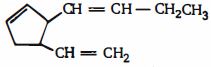
Compound $(X)$ will be

Compound $(X)$ $\xrightarrow[{Pt}]{{5{H_2}}}$ 

Compound $(X)$ $\xrightarrow{{AgN{O_3}}}$ Precipitate

Compound $(X)$ $\xrightarrow[{M{e_2}S}]{{{O_3}}}$ $\begin{array}{*{20}{c}}
  {\,\,\,\,\,\,\,O\,\,\,\,\,\,\,\,\,\,\,\,\,\,\,\,\,\,\,\,\,\,\,\,\,\,\,\,\,\,\,\,\,\,\,\,\,\,\,\,\,\,\,O\,\,\,\,\,\,\,\,\,\,O\,\,\,\,} \\ 
  {\,\,\,\,\,\,\,\,\,\,\,\,\,\,\,\,\,\,\,||\,\,\,\,\,\,\,\,\,\,\,\,\,\,\,\,\,\,\,\,\,\,\,\,\,\,\,\,\,\,\,\,\,\,\,\,\,\,\,\,\,\,\,\,\,||\,\,\,\,\,\,\,\,\,\,||\,\,\,\,\,\,\,\,\,\,\,\,\,\,\,\,\,\,} \\ 
  {H - C - C{H_2} - C{H_2} - C - C - H} 
\end{array}$ $\begin{array}{*{20}{c}}
  {\,\,O\,\,\,\,\,\,O\,\,\,\,\,\,\,\,\,\,} \\ 
  {||\,\,\,\,\,\,\,\,||\,\,\,\,\,\,\,\,\,} \\ 
  {H - C - C - O - H} 
\end{array}$ $ + \begin{array}{*{20}{c}}
  {O\,\,\,\,\,\,\,} \\ 
  {||\,\,\,\,\,\,\,\,} \\ 
  {H - C - O - H} 
\end{array}$ $ + \begin{array}{*{20}{c}}
  {CHO} \\ 
  {|\,\,\,\,\,\,\,\,} \\ 
  {CHO} 
\end{array}$