MCQ
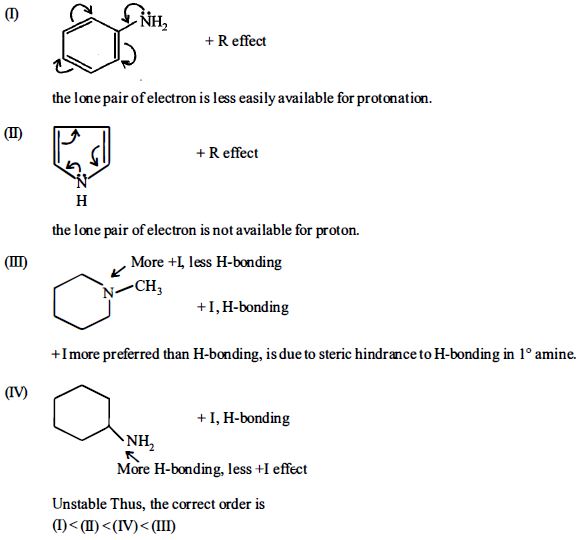
Among the following compounds, the increasing order of their basic strength is
  • $(I) < (II) < (IV) < (III)$
  • B
    $(I) < (II) < (III) < (IV)$
  • C
    $(II) < (I) < (IV) < (III)$
  • D
    $(II) < (I) < (III) < (IV)$

Answer

Correct option: A.
$(I) < (II) < (IV) < (III)$
a

Need a full question paper?

Generate a complete, print-ready paper with questions like this in minutes — across 16+ boards, with answer keys.

Start Generating Free

Similar questions

Reaction of $x g$ of $Sn$ with $HCl$ quantitatively produced a salt. Entire amount of the salt reacted with $y g$ of nitrobenzene in the presence of required amount of $HCl$ to produce $1.29 g$ of an organic salt (quantitatively).

($1$) The value of $x$ is. . . . . 

($2$) The value of $y$ is. . . . . 

Arrange these compounds in decreasing order of reactivity for the nucleophilic addition reaction :

$(I)$ Acid chloride                   $(II)$ Aldehyde

$(III)$ Ketone                          $(IV)$ Ester

Select the correct answer from the codes given below :

If Hund's Rule does not hold good, then which of the following pairs is diamagnetic
Correct statements among $i$ to $iv$ regarding silicones are

$(i)$ they are polymers with hydrophobic character

$(ii)$ they are biocompatible

$(iii)$ in general, they have high thermal stability and low dielectric strength

$(iv)$ usually they are resistant to oxidation and used as greases.

If $Cu^+ + e^-\to Cu$ ; $E^o = X_1$

$Cu^{+2} + 2e^-\to Cu$ ; $E^o = X_2$ then the value of $E^o$ for $Cu^{+2} + e^-\to Cu^+$ will be
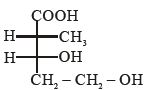
What are the configuration of the two chiral centre?
The hydration energies of $\mathrm{K}^{+}$and $\mathrm{Cl}^{-}$are -x and -y $\mathrm{kJ} / \mathrm{mol}$ respectively. If lattice energy of KCl is -z $\mathrm{kJ} / \mathrm{mol}$, then the heat of solution of KCl is :
The number of $d-$ electrons in $F{e^{2 + }}$ (at no. of $Fe = 26$) is not equal to that of the
Total number of deactivating groups in aromatic electrophilic substitution reaction among the following is
The wavelength of an electron of kinetic energy $4.50 \times 10^{-29}\,J$ is $\ldots . . \times 10^{-5}\,m$. (Nearest integer)Given : mass of electron is $9 \times 10^{-31}\,kg , h =6.6 \times$ $10^{-34}\,J s$