MCQ
Among the following elements, the one having the highest ionisation energy is :-
  • A
    $(Ne) 3s^2 3p^1$
  • B
    $(Ne) 3s^2 3p^4$
  • $(Ne) 3s^2p^3$
  • D
    $(Ar) 3d^{10} 4s^2 4p^2$

Answer

Correct option: C.
$(Ne) 3s^2p^3$
c
The IE increases along a period and decreases down the group. Also, IE of 15 is more than group 16 as group 15 has half-filled p subshell giving extra stability.
Thus among given option highest IE is of option B i.e. $[N e] 3 s^{2} 3 p^{3}$.

Need a full question paper?

Generate a complete, print-ready paper with questions like this in minutes — across 16+ boards, with answer keys.

Start Generating Free

Similar questions

$\ce{[Co(NH_3)_4(NO_2)_2]Cl}$ exhibits
Bromination of alkanes involves
Decreasing order of reactivity of $HX$ in the reaction $ROH + HX \to RX + {H_2}O$
Chiral complex from the following is :

Here en $=$ ethylene diamine

$\underset{(A)}{\mathop{\begin{matrix}
   \,\,\,\,\,Ph\,\,\,\,C{{H}_{3}}  \\
   |\,\,\,\,\,\,\,\,\,\,|\,\,  \\
   Ph-C-C-C{{H}_{3}}  \\
   |\,\,\,\,\,\,\,\,\,\,|\,\,\,  \\
   \,OH\,\,\,OH  \\
\end{matrix}}}\,+\underset{(B)}{\mathop{\begin{matrix}
   \,\,\,\,Ph\,\,\,Et  \\
   \,\,|\,\,\,\,\,\,\,\,\,|  \\
   Ph-C-C-Et  \\
   \,\,|\,\,\,\,\,\,\,\,\,|  \\
   \,\,\,\,\,OH\,\,OH  \\
\end{matrix}}}\,\xrightarrow{{{H}_{2}}S{{O}_{4}}}$


$(p)$ $\begin{matrix}
   Ph\,\,\,\,\,O\,  \\
   |\,\,\,\,\,\,\,\,||\,\,  \\
   Ph-C-C-C{{H}_{3}}  \\
   |\,\,\,\,\,\,\,\,\,\,\,\,  \\
   C{{H}_{3}}\,\,\,\,\,\,\,\,  \\
\end{matrix}$                                $(q)$ $\begin{matrix}
   \,Ph\,\,\,\,\,O\,  \\
   \,\,|\,\,\,\,\,\,\,\,||  \\
   Ph-C-C-Et  \\
   |\,\,\,\,\,\,\,\,\,\,  \\
   Et\,\,\,\,\,\,\,\,\,\,  \\
\end{matrix}$

$(r)$ $\begin{matrix}
   \,Ph\,\,\,\,\,O\,  \\
   |\,\,\,\,\,\,\,\,\,\,||\,  \\
   Ph-C-C-C{{H}_{3}}  \\
   |\,\,\,\,\,\,\,\,\,\,\,\,\,\,  \\
   Et\,\,\,\,\,\,\,\,\,\,\,\,\,  \\
\end{matrix}$                             $(s)$ $\begin{matrix}
   \,\,\,Ph\,\,\,\,\,O\,  \\
   \,\,|\,\,\,\,\,\,\,\,||  \\
   Ph-C-C-Et  \\
   |\,\,\,\,\,\,\,\,\,\,  \\
   C{{H}_{3}}\,\,\,\,  \\
\end{matrix}$

When $(A)$ and $(B)$ reacts with $H_2SO_4$ products obtained are

The smallest compound, which on photochlorination produces diastereomers is
In the reaction sequence :

$\begin{array}{*{20}{c}}
  {C{H_3} - CH - COOH} \\ 
  {|\,\,\,\,\,\,\,\,\,\,\,\,\,} \\ 
  {OH\,\,\,\,\,\,\,\,\,} 
\end{array}\xrightarrow{\Delta }[Y]$

$[Y]$ will be :
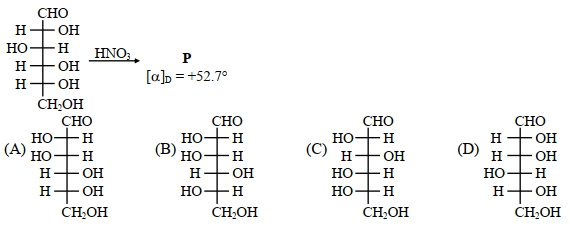
Given  $D$-Glucose  The compound($s$), which on reaction with $HNO _3$ will give the product having degree of rotation, $[\alpha]_{ D }=-52.7^{\circ}$ is (are)
Which molecule has zero dipole moment
When $N{H_4}Cl$ is added to $N{H_4}OH$ solution, the dissociation of ammonium hydroxide is reduced. It is due to