Question
Among the following, $L-$ serine is
serine is (figure)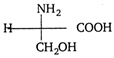
Generate a complete, print-ready paper with questions like this in minutes — across 16+ boards, with answer keys.
$C{H_3} - C \equiv CH\xrightarrow[{(ii)\,\,NaB{H_4}}]{{(i)\,\,Hg{{(OAC)}_2}/{H_2}O}}\,(Q)$
Choose the correct option
${A_2}B(g) \to {A_2}(g) + B(g);\,\,\,\Delta {H^o} = 40\,kJ/mol$
${A_2}B(g) \to A(g) + AB(g);\,\,\,\Delta {H^o} = 50\,kJ/mol$
.....$ kJ/mol$
$(i)$ Pyro silicate
$(ii)$ Cyclic silicate
$(iii)$ Double chain silicate
$(iv)$ Single chain silicate
$(v)$ $3D$ silicate
$(vi)$ Sheet silicate
$M{n_{(S)}}|Mn_{(aq)}^{ + 2}(0.4\,M)||Sn_{(aq)}^{ + 2}(0.04\,M)|S{n_{(S)}}$,
Calculate free energy change $(\Delta G)$ at $298\,K$ .
Given :$E_{M{n^{ + 2}}|Mn}^o = \, - \,1.18\,V\,;\,E_{S{n^{ + 2}}|Sn}^o\, = \, - \,0.14\,volt$
$\frac{{2.303\,RT}}{F} = 0.06$
$Image$
| LIST-I (Test) | LIST-II (Observation) | ||
| A. | $Br _2$ water test | I. | Yellow orange or orange red precipitate formed |
| B. | Ceric ammonium nitrate test | II. | Reddish orange colour disappears |
| C. | Ferric chloride test | III. | Red colour appears |
| D. | 2, 4-DNP test | IV. | Blue, Green, Violet or Red colour appear |