MCQ
Among the following orbitals bond angle is minimum between
  • A
    $sp^3$
  • $P_x\,\,$ and $\,\,P_y$  orbitals
  • C
    $H-O-H$  bond in water
  • D
    $sp$

Answer

Correct option: B.
$P_x\,\,$ and $\,\,P_y$  orbitals
b
${P_x}\,\,\, \bot \,\,{P_y}\,\, = \,\,{90^o}$

Need a full question paper?

Generate a complete, print-ready paper with questions like this in minutes — across 16+ boards, with answer keys.

Start Generating Free

Similar questions

Compound Total stereoisomere
$(A)\, [Co(en)_2 \,Cl_2]^+$ $(P)\, 2$
$(B)\, [Co(en)_3]\, Cl_3$ $(Q)\, 3$
$(C) \,[Pt(NH_3)_2 \,Cl_2]$ $(R)\, 4$
$(D)\, [Pt(NH_3)_3 \,Cl_3]^+$ $(S)\, 5$

Correct code

Benzene is obtained from
If $E.A.N.$ of central metal cation $M^{2+}$ in a non-chelating complex is $36$  and  atomic no. of metal $M$ is $26$, then the number of monodentate ligand is in  this complex are
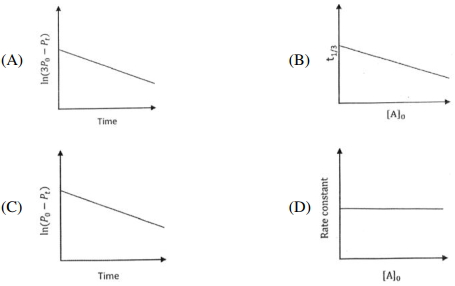
For a first order reaction $A ( g ) \rightarrow 2 B ( g )+ C ( g )$ at constant volume and $300 K$, the total pressure at the beginning $(t=0)$ and at time $t$ are $P_0$ and $P_t$, respectively. Initially, only $A$ is present with concentration $[ A ]_0$, and $t _{1 / 3}$ is the time required for the partial pressure of A to reach $1 / 3^{\text {rd }}$ of its initial value. The correct option(s) is (are) (Assume that all these gases behave as ideal gases)
Solubility product $(K_{sp})$ of the salts $MX\,,\, MX_2\,,\, M_3X$ at temperature $'T'$ are $4 \times 10^{-8}\,,\, 3.2 \times 10^{-14}$ and $2.7 \times 10^{-15}$ respectively. Solubilities of the salt at temperature $'T'$ are in the order
Which of the following has zero dipole moment
When the first electron gain enthalpy $(\Delta _{eg}H)$ of oxygen is $-141\,kJ/mol,$ its second electron gain enthalpy is
What is the $[OH^-]$ in the final solution prepared by mixing $20.0\, mL$ of $0.050\, M\, HCl$ with $30.0\, mL$ of $0.10\, M\, Ba(OH)_2$ ? .......$M$
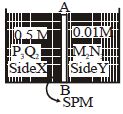
$0.5\,M$ , $P_3Q_2(i = 5)$ when reacted with $0.01\,M$ , $M_2N_3(i = 5)$ in aqueous solution gives brown colour. These are separated by a semipermeable membrane $AB$ as shown Due to osmosis there is
The equivalent weight of $Cr _2\left( SO _4\right)_3[mol, wt = M ]$ in the following reaction is $Cr _2\left( SO _4\right)_3+ H _2 O _2+ NaH \rightarrow Na _2 CrO _4+ Na _2 SO _4+ H _2 O$