MCQ
Among the following, the compound that is both paramagnetic and coloured is
- A$K_2Cr_2O_7$
- B$(NH_4)_2[TiCl_6]$
- ✓$VOSO_4$
- D$K_3[Cu(CN)_4]$
$Cr ^{-6}=[ Ar ] 3 d ^0$
In $\left( NH _4\right)_2\left[ TiCl _6\right]$, the oxidation state of $Ti$ is $+4$.
$Ti ^{+4}=[ Ar ] 3 d ^0$
In $VOSO _4$, the oxidation state of $V$ is $+4$.
$V ^{+4}=[ Ar ] 3 d ^1$
In $K _3\left[ Cu ( CN )_4\right]$, the oxidation state of $Cu$ is $+1$.
$Cu ^{+1}=[ Ar ] 3 d ^{10}$
In $VOSO _4, V ^{+4}$ configuration is $d ^1$, so it has one unpaired d-electron so it is paramagnetic and colored. All other compounds don't have any unpaired $d$ electrons, so they are diamagnetic in nature.
Generate a complete, print-ready paper with questions like this in minutes — across 16+ boards, with answer keys.
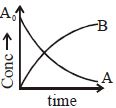
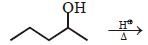
$(b)$ Tertiary alcohol $\xrightarrow[\Delta ]{{{H_3}P{O_4}}}$
For above dehydration reaction rate of reaction will be
${C_6}{H_5}CHO+X\mathop {\xrightarrow{{(i)\,Zn\,\,\,\,\,\,\,\,\,\,\,\,\,\,\,\,}}}\limits_{(ii)\,HOH/N{H_4}Cl} \begin{array}{*{20}{c}}
{OH\,\,\,\,\,\,\,\,\,\,\,\,\,\,\,\,\,\,\,\,\,\,\,\,\,\,\,\,\,\,\,\,\,\,\,} \\
{|\,\,\,\,\,\,\,\,\,\,\,\,\,\,\,\,\,\,\,\,\,\,\,\,\,\,\,\,\,\,\,\,\,\,\,\,\,\,} \\
{{C_6}{H_5} - CH - C{H_2} - COO{C_2}{H_5}}
\end{array}$
$[X]$ will be:
(Given atomic member $\mathrm{V}=23, \mathrm{Mn}=25, \mathrm{Cr}=24$ )