MCQ
Among the given compounds, the correct dehydration order is :
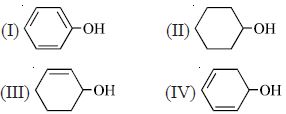
  • $I < II < III < IV$
  • B
    $II < III < IV < I$
  • C
    $I < III < IV < II$
  • D
    $I < II < III = IV$

Answer

Correct option: A.
$I < II < III < IV$
a
Dehydration order is according to the stability of their intermediate. Benzylic carbocation is most stable due to resonance so $IV$ has the highest order. As allylic carbocation are more stable than $2^{\circ}$ carbocation, so the order is $III\, >\, II$.

Phenyl carbocations are least stable, so the order is $I\, <\, II\, < \,III \,<\, IV$.

Need a full question paper?

Generate a complete, print-ready paper with questions like this in minutes — across 16+ boards, with answer keys.

Start Generating Free

Similar questions

Each quantum mechanical wave function does not have a readily interpretable physical meaning, but the square of the wave function gives the _______ of finding the electron at a certain point.
$[IMAGE]\,\,\xrightarrow[\Delta ]{{Alc.KOH}}$  Major product
During which of the following processes, does entropy decrease ?

$(A)$ Freezing of water to ice at $0^{\circ} C$

$(B)$ Freezing of water to ice at $-10^{\circ} C$

$(C)$ $N _{2}( g )+3 H _{2}( g ) \rightarrow 2 NH _{3}( g )$

$(D)$ Adsorption of $CO ( g )$ and lead surface

$(E)$ Dissolution of $NaCl$ in water

Simplest alkyne is represented by
Internal energy does not include
A mixture of gases contains $H_2$ and $O_2$ gases in the ratio of $1 : 4\ (w/w).$ What is the molar ratio of the two gases in the mixture?
Based on Heisenberg's uncertainty principle, the uncertainty in the velocity of the electron to be found within an atomic nucleus of diameter $10^{-15} \mathrm{~m}$ is ............. $\times 10^9 \mathrm{~ms}^{-1}$ (nearest integer)

[Given : mass of electron $=9.1 \times 10^{-31} \mathrm{~kg}$, Plank's constant $(\mathrm{h})=6.626 \times 10^{-34} \mathrm{JS}$ ]

(Value of $\pi=3.14$ )

When the first electron gain enthalpy $(\Delta _{eg}H)$ of oxygen is $-141\,kJ/mol,$ its second electron gain enthalpy is
You are given $500\, mL$ of $2\,N\, HCl$ and $500\, mL$ of $5\,N\, HCl$. What will be the maximum volume of $3\, M\, HCl$ that you can make from these two sotutions ? .............. $\mathrm{mL}$
The increasing order of stability of the following free radicals: