Question
Ampere’s circuital law states that:

Answer

  1. The line integral of magnetic field along the boundary of the open surface is equal to μ0 times the total current passing through the surface.

Need a full question paper?

Generate a complete, print-ready paper with questions like this in minutes — across 16+ boards, with answer keys.
Start Generating Free

Similar questions

A body is rotating nonuniformity about a vertical axis fixed in an inertial frame. The resultant force on a particle of the body not on the axis is:
  1. Vertical.
  2. Horizontal and skew with the axis.
  3. Horizontal and intersecting the axis.
  4. None of these.
Lens used to remove long sightedness (hypermetropia) is(a) Concave lens (b) Plano-concave lens (c) Convexo-concave lens(d) Convex lens 
   
   
Energy of an electron in an excited hydrogen atom is $– 3.4 eV.$ Its angular momentum will be: $h = 6.626 \times 10^{-34} \mathrm{~J}-\mathrm{s}$ 
The magnetic induction at a point $P$ which is distant $4 \ cm$ from a long current carrying wire is $10^{-18}$ Tesla. The field of induction at a distance $12 \ cm$ from the same current would be
The two ends of a spring are displaced along the length of the spring. All displacement have equal magnitudes. In which case or cases the tension or compression in the spring will have a maximum magnitude?
  1. The right end is displaced towards right and the left end towards left.
  2. Both ends are displaced towards right.
  3. Both ends are displaced towards left.
  4. The right end is displaced towards left and the left end towards right.
Consider the following two statements:
  1. The linear momentum of a particle is independent of the frame of reference.
  2. The kinetic energy of a particle is independent of the frame of reference.
  1. Both A and B are true.
  2. A is true but B is false.
  3. A is false but B is true.
  4. Both A and B are false.
When air in a capacitor is replaced by a medium of dielectric constant $K,$ the capacity
When the electron in the hydrogen atom jumps from $2^{nd}$ orbit to $1^{st}$ orbit, the wavelength of radiation emitted is ?. When the electrons jump from $3^{rd}$ orbit to $1^{st}$ orbit, the wavelength of emitted radiation would be
A point $Q$ lies on the perpendicular bisector of an electrical dipole of dipole moment $p$. If the distance of $Q$  from the dipole is $r\ ($much larger than the size of the dipole$),$ then electric field at $Q$ is proportional to
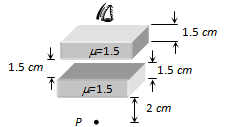
The image of point $P$ when viewed from top of the slabs will be