MCQ
Amphibian heart is
- AOne-chambered
- ✓Three-chambered
- CTwo-chambered
- DFour-chambered
Generate a complete, print-ready paper with questions like this in minutes — across 16+ boards, with answer keys.
$I.$ The polarity of the membrane at site $A$ is reversed and depolarized, i.e., the outer surface becomes negatively charged and the innerside becomes positively charged, generating nerve impulse
$II$. A stimulus causes disturbance to the membrane at site of $A$ nerve fibre resulting in leakage of $N a^{+i i}$ ions inside the nerve fibre
$III.$ On the outer surface, current flows from site $B$ to site $A$ to complete the circuit of current flow. Hence, the polarity at the site is reversed, and an action potential is generated at site $B.$ The impulse (action potential) generated at site $A$ arrives at site $B .$ The sequence is repeated along the length of the axon and consequently the impulse is conducted
$IV.$ Immediately ahead, the axon $(e \cdot g .$, site $B )$ membrane has a positive charge on the outer surface and a negative charge on its inner surface. As a result, a current flows on the inner surface from site $A$ to site $B$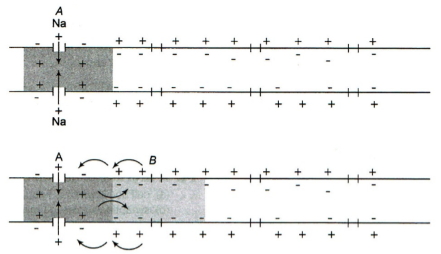
$\begin{array}{|l|l|} \hline Column\;-\;I & Column\;-\;II \\ \hline A.\;Areolar\;tissue & 1.\;Fat\;cells \\ \hline B.\;Adipose\;tissue & 2.\;Osteocytes \\ \hline C.\;Ligament & 3.\;Loose\;connective\;tissue \\ \hline D.\;Bone & 4.\;Dense\;regular\;connective\;tissue \\ \hline \end{array}$
| Cholera | - | A type of disease |
| Mycorrhiza | - | A type of disease |
| Lichen | - | A type of pathogen |
| BSE | - | A type of symbiotic association |