Question
An $AC$ source is connected to a capacitor. Will the rms current increase, decrease or remain constant if a dielectric slab is inserted into the capacitor?

Answer

$\text{X}_\text{c}=\frac{1}{\omega\text{C}}$ as slab is introduced $C$ increases and $X_C$ decreases so current increases.

Need a full question paper?

Generate a complete, print-ready paper with questions like this in minutes — across 16+ boards, with answer keys.
Start Generating Free

Similar questions

Water is slowly coming out from a vertical pipe. As the water descends after coming out, its area of cross-section reduces. Explain this on the basis of the equation of continuity.
A gas is kept in a rigid cubical container. If a load of 10kg is put on the top of the container, does the pressure increase?
Two wave pulses identical in shape but inverted with respect to each other are produced at the two ends of a stretched string. At an instant when the pulses reach the middle, the string becomes completely straight. What happens to the energy of the two pulses?
Why does sun appear red at sunrise and sunset?
A block of mass $100g$ slides on a rough horizontal surface. If the speed of the block decreases from $10\ ms^{-1}$ to $5\ ms^{-1},$ find the thermal energy developed in the process.
A metallic metre stick moves with a velocity of $2m/s^{-1}$ in a direction perpendicular to its length and perpendicular to a uniform magnetic field of magnitude $0.2 T.$ Find the emf induced between the ends of the stick.
What is the net charge on a given piece of:
  1. p-type semiconductor.
  2. n-type semiconductor?
Answer the following questions, which help you understand the difference between Thomson’s model and Rutherford’s model better.
Is the probability of backward scattering (i.e., scattering of α-particles at angles greater than 90°) predicted by Thomson’s model much less, about the same, or much greater than that predicted by Rutherford’s model?
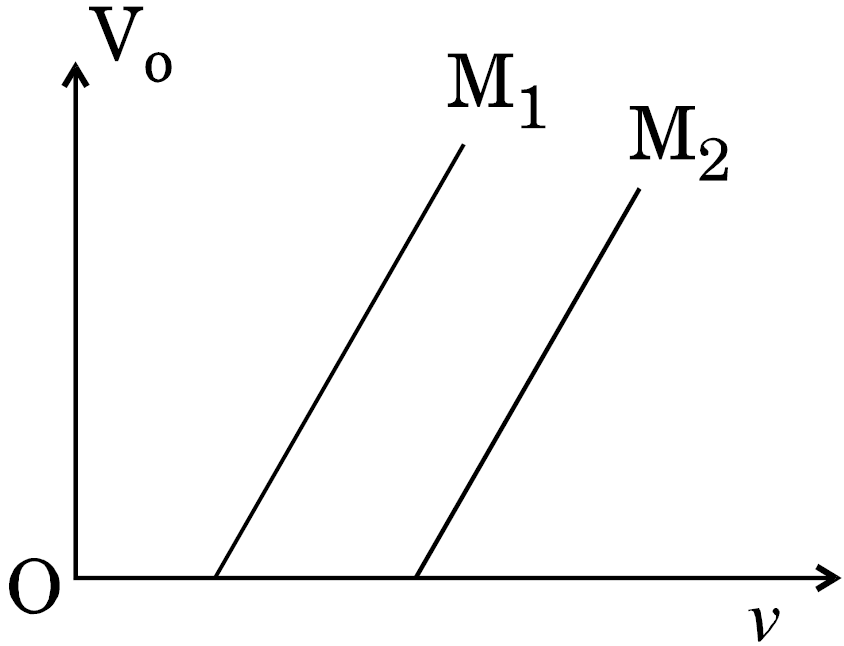
The variation of the stopping potential $(V_0)$ with the frequency $(v)$ of the light incident on two different photosensitive surfaces $M_1$ and $M_2$ is shown in the figure. Identify the surface which has greater value of the work function.
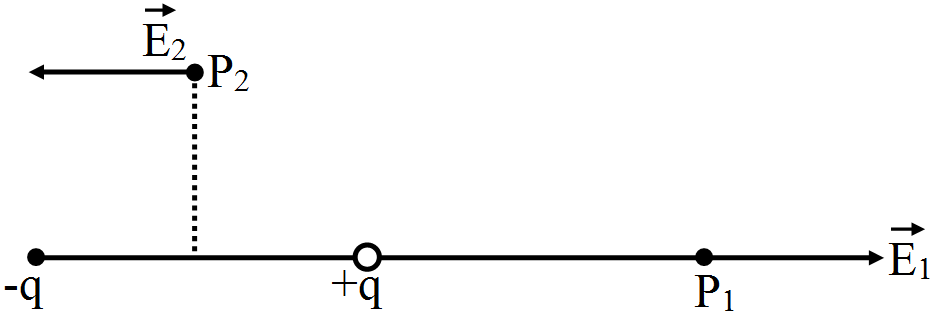
What is the angle between the directions of electric field at any $(i)$ Axial point and $(ii)$ Equatorial point due to an electric dipole?