Question
An AC source is connected to a diode and a resistor in series. Is the current thorough the resistor AC or DC?

Answer

If the diode and resistor are in series, for the positive half cycle of AC, the current through the resistor will be DC. But for the next half cycle the current through the resistor will be zero. As a diode is a device that converts AC into DC, current through the resistor will be DC.

Need a full question paper?

Generate a complete, print-ready paper with questions like this in minutes — across 16+ boards, with answer keys.
Start Generating Free

Similar questions

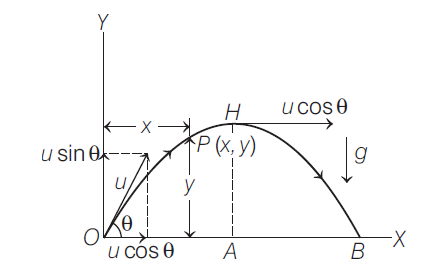
Read the passage given below and answer the following questions from 1 to 5. Projectile motion is a form of motion in which an object or particle is thrown with some initial velocity near the earth’s surface and it moves along a curved path under the action of gravity alone. The path followed by a projectile is called its trajectory, which is shown below. When a projectile is projected obliquely, then its trajectory is as shown in the figure below. Here velocity u is resolved into two components, we get (a) u cosθ along OX and (b) u sinθ along OY.
  1. The example of such type of motion is:
  1. Motion of car on a banked road.
  2. Motion of boat in sea.
  3. A javelin thrown by an athlete.
  4. Motion of ball thrown vertically upward.
  1. The acceleration of the object in horizontal direction is:
  1. Constant
  2. Decreasing
  3. Increasing
  4. Zero
  1. The vertical component of velocity at point H is:
  1. Maximum
  2. Zero
  3. Double to that at O
  4. Equal to horizontal component
  1. A cricket ball is thrown at a speed of 28m/s in a direction 30° with the horizontal. The time taken by the ball to return to the same level will be:
  1. 2.0s
  2. 3.0s
  3. 4.0s
  4. 2.9s
  1. In above case, the distance from the thrower to the point where the ball returns to the same level will be:
  1. 39m
  2. 69m
  3. 68m
  4. 72m
Read the passage given below and answer the following questions from 1 to 5. We know that the earth attracts every object with a certain force and this force depends on the mass (m) of the object and the acceleration due to the gravity (g). The weight of an object is the force with which it is attracted towards the earth. Mathematically Where, W = weight of object m = mass of object g = acceleration due to the gravitational force As the weight of an object is the force with which it is attracted towards the earth, the SI unit of weight is the same as that of force, that is, Newton (N). The weight is a force acting vertically downwards; it has both magnitude and direction. We have learnt that the value of g is constant at a given place. Therefore at a given place, the weight of an object is directly proportional to the mass, say m, of the object, that is, W α m. It is due to this reason that at a given place, we can use the weight of an object as a measure of its mass. Answer the following questions.
  1. Dimensions of acceleration due to the gravity (g) is:
  1. $[ML^1 T^{-2}]$
  2. $[ML^{-1} T^{-2}]$
  3. $[ML^1 T^{-3}]$
  4. None of these
  1. SI unit of weight is same as:
  1. Force
  2. Mass
  3. Acceleration due to gravity
  4. None of these
  1. Which of the following has same unit?
  1. Mass and weight
  2. Weight and force
  3. Pressure and stress
  4. Both b and c
  1. Whether weight is scalar quantity or vector quantity? Justify your answer.
  1. Differentiate between mass and weight.
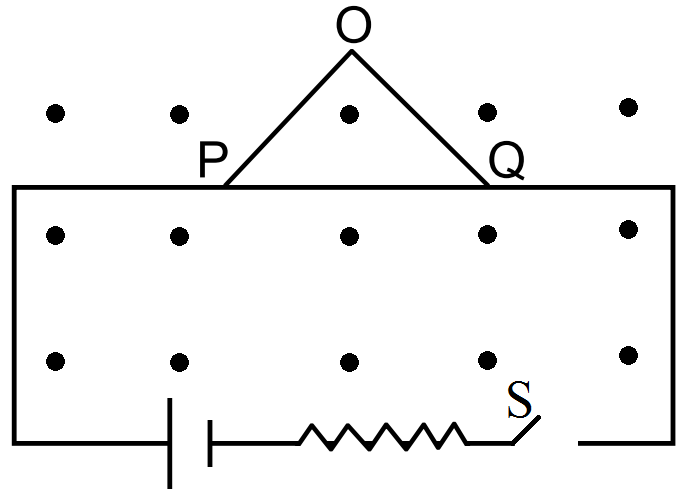
Shows a rod PQ of length 20.0cm and mass 200g suspended through a fixed point O by two threads of lengths 20.0cm each. A magnetic field of strength 0.500T exists in the vicinity of the wire PQ, as shown in the figure. The wires connecting PQ with the battery are loose and exert no force on PQ.
  1. Find the tension in the threads when the switch S is open.
  2. A current of 2.0A is established when the switch S is closed. Find the tension in the threads now.
Read the passage given below and answer the following questions from i to v. If an object moving along the straight line covers equal distances in equal intervals of time, it is said to be in uniform motion along a straight line. Distance and displacement are two quantities that seem to mean the same but are different with different meanings and definitions. Distance is the measure of actual path length travelled by object. It is scalar quantity having SI unit of metre while displacement refers to the shortest distance between initial and final position of object. It is vector quantity. The magnitude of the displacement for a course of motion may be zero but the corresponding path length is not zero. using this data answer following questions.
  1. Can path length be zero for motion of body from one point to other point?
  1. Yes
  2. No
  1. For any given motion from point A to B, displacement =10m and distance = 5m. Is it possible?
  1. Yes
  2. No
  1. For rectilinear motion displacement can be
  1. Positive only
  2. Negative only
  3. Can be zero
  4. All of the above
  1. Define distance and displacement of particle.
  1. Write difference between distance and displacement.
$\int\frac{\text{dx}}{\sqrt{2\text{ax}-\text{x}^2}}=\text{a}^{\text{n}}\sin^{-1}\Big[\frac{\text{x}}{\text{a}}-1\Big].$ The value of n is:
When an object is in motion, its position changes with time. So, the quantity that describes how fast is the position changingm w.r.t. time and in what direction is given by average velocity. It is defined as the change in position or displacement $(\triangle\text{x})$ divided by the time interval $(\triangle\text{t})$ in which that displacement occur. However, the quantity used to describe the rate of motion over the actual path, is average speed. It defined as the total distance travelled by the object divided by the total time taken.
  1. A $250m$ long train is moving with a uniform velocity of $45\ kmh^{-1}.$ The time taken by the train to cross a bridge of length $750m$ is:
  1. $56s$
  2. $68s$
  3. $80s$
  4. $92s$
  1. A truck requires 3hr to complete a journey of $150\ km$. What is average speed?
  1. $50\ km/h$
  2. $25\ km/h$
  3. $15\ km/h$
  4. $10\ km/h$
  1. Average speed of a car between points $A$ and $B$ is $20\ m/s$, between $B$ and $C$ is 15m/s and between $C$ and $D$ is $10\ m/s.$ What is the average speed between $A$ and $D$, if the time taken in the mentioned sections is $20s, 10s$ and $5s,$ respectively?
  1. $17.14\ m/s$
  2. $15\ m/s$
  3. $10\ m/s$
  4. $45\ m/s$
  1. A cyclist is moving on a circular track of radius 40m completes half a revolution in $40s.$ Its average velocity is:
  1. $\text{Zero}$
  2. $2\text{ms}^{-1}$
  3. $4\pi\text{ms}^{-1}$
  4. $8\pi\text{ms}^{-1}$
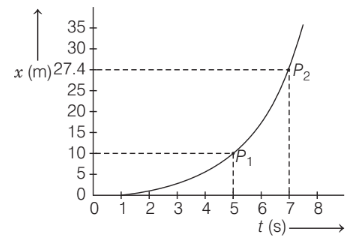
  1. In the following graph, average velocity is geometrically represented by:
  1. Length of the line $P_1 P_2.$
  2. Slope of the straight line $P_1 P_2.$
  3. Slope of the tangent to the curve at $P_1.$
  4. Slope of the tangent to the curve at $P_2.$
Suppose you are inside the water in a swimming pool near an edge. A friend is standing on the edge. Do you find your friend taller or shorter than his usual height?
Read the passage given below and answer the following questions from (i) to (v). This principle is a consequence of Newton’s second and third laws of motion. In an isolated system (i.e. a system having no external force), mutual forces (called internal forces) between pairs of particles in the system causes momentum change in individual particles. Let a bomb be at rest, then its momentum will be zero. If the bomb explodes into two equal parts, then the parts fly off in exactly opposite directions with same speed, so that the total momentum is still zero. Here, no external force is applied on the system of particles (bomb).
  1. A bullet of mass 10g is fired from a gun of mass 1kg with recoil velocity of gun 5m/ s. The muzzle velocity will be:
  1. 30km/ min
  2. 60km/ min
  3. 30m/ s
  4. 500m/ s
  1. A shell of mass 10 kg is moving with a velocity of 10 ms" 1 when it blasts and forms two parts of mass 9 kg and 1 kg respectively. If the first mass is stationary, the velocity of the second is:
  1. $1ms^{-1}$
  2. $10ms^{-1}$
  3. $100ms^{-1}$
  4. $1000ms^{-1}$
  1. A bullet of mass 0.1kg is fired with a speed of 100ms’ 1 . The mass of gun being 50kg, then the velocity of recoil becomes:
  1. $0.05ms^{-1}$
  2. $0.5ms^{-1}$
  3. $0.lms^{-1}$
  4. $0.2ms^{-1}$
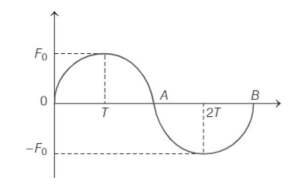
  1. A unidirectional force F varying with time Tas shown in the figure acts on a body initially at rest for a short duration:
2.T. Then, the velocity acquired by the body is
  1. $\frac{\pi\text{F}_\text{o}\text{T}}{4\text{m}}$
  2. $\frac{\pi\text{F}_\text{o}\text{T}}{2\text{m}}$
  3. $\frac{\text{F}_\text{o}\text{T}}{4\text{m}}$
  4. $\text{zero}$
  1. Two masses ofM and 4Af are moving with equal kinetic energy. The ratio of their linear momenta is
  1. $1 : 8$
  2. $1 : 4$
  3. $1 : 2$
  4. $4 : 1$
An ideal gas is pumped into a rigid container having diathermic walls so that the temperature remains constant. In a certain time interval, the pressure in the container is doubled. Is the internal energy of the contents of the container also doubled in the interval?
When you push your bicycle up on an incline the potential energy of the bicyle and yourself increases. Where does this energy come from?