MCQ
An achromatic combination of lenses produce:
- AImages in black and white
- BColored images
- CImages unaffected by variation of refractive index with wavelength
- DHighly enlarged images
An achromatic combination of lenses produce:
Explanation:
An achromatic combination of lenses provide deviation without dispersion. So, images are unaffected by variation of refractive index with wavelength.
Generate a complete, print-ready paper with questions like this in minutes — across 16+ boards, with answer keys.
Assertion : A potentiometer of longer length is used for accurate measurement.
Reason : The potential gradient for a potentiometer of longer length with a given source of e.m.f. becomes small.
|
(a) If both assertion and reason are true and the reason is the correct explanation of the assertion. |
|
(b) If both assertion and reason are true but reason is not the correct explanation of the assertion. |
|
(c) If assertion is true but reason is false. |
|
(d) If the assertion and reason both are false. |
If no external voltage is applied across P-N junction, there would be
|
(a) No electric field across the junction |
|
(b) An electric field pointing from N-type to P-type side across the junction |
|
(c) An electric field pointing from P-type to N-type side across the junction |
|
(d) A temporary electric field during formation of P-N junction that would subsequently disappear |
In the circuit shown here, what is the value of the unknown resistor R so that the total resistance of the circuit between points P and Q is also equal to R
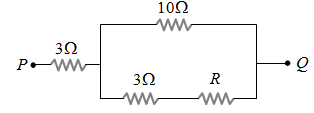
|
(a) 3 ohms |
(b) |
(c) |
(d) 10 ohms |
The figure illustrate how B, the flux density inside a sample of unmagnetised ferromagnetic material varies with B0, the magnetic flux density in which the sample is kept. For the sample to be suitable for making a permanent magnet

|
(a) OQ should be large, OR should be small |
|
(b) OQ and OR should both be large |
|
(c) OQ should be small and OR should be large |
|
(d) OQ and OR should both be small |
Two equally charged, identical metal spheres A and B repel each other with a force 'F'. The spheres are kept fixed with a distance 'r' between them. A third identical, but uncharged sphere C is brought in contact with A and then placed at the mid-point of the line joining A and B. The magnitude of the net electric force on C is
|
(a) F |
(b) 3F/4 |
(c) F/2 |
(d) F/4 |

