MCQ
An acidic buffer solution can be prepared by mixing the solution of
  • sodium acetate and acetic acid
  • B
    ammonium chloride and ammonium hydroxide
  • C
    sulphuric acid and sodium hydroxide
  • D
    sodium chloride and sodium hydroxide

Answer

Correct option: A.
sodium acetate and acetic acid
a
A mixture of acetic acid and sodium acetate acts as a buffer since sodium acetate is the conjugate base of acetic acid. Its $pH$ around $4.75$.

Need a full question paper?

Generate a complete, print-ready paper with questions like this in minutes — across 16+ boards, with answer keys.

Start Generating Free

Similar questions

Which of the following is the most electropositive element
Polyvinylalcohol can be prepared by
The oxidation number of $N$ in $N{H_4}Cl$ is
Atmospheric pressures recorded in different cities are as follows :
Cities
Shimla
Bengaluru
Delhi
Mumbai
$p$ in $N/ m^2$
$1.01 \times 10^5$
$1.2 \times 10^5$
$1.02 \times 10^5$
$1.21 \times 10^5$
Consider the above data and mark the place at which liquid will boil first.
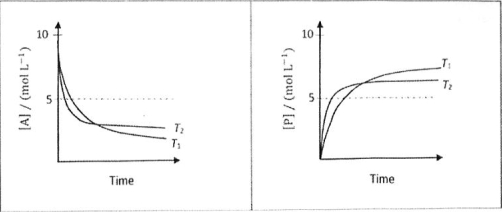
For a reaction, $A \rightleftharpoons P$, the plots of $[ A ]$ and $[ P ]$ with time at temperatures $T _1$ and $T _2$ are given below.

If $T _2> T _1$, the correct statement(s) is (are)

(Assume $\Delta H ^{\ominus}$ and $\Delta S ^{\ominus}$ are independent of temperature and ratio of $\ln K$ at $T _1$ to $\ln K$ at $T_2$ is greater than $T_2 / T_1$. Here $H, S, G$ and $K$ are enthalpy, entropy, Gibbs energy and equillibrium constant, respectively.)

$(A)$ $\Delta H ^{\ominus}<0, \Delta S ^{\ominus}<0$  $(B)$ $\Delta G ^{\ominus}<0, \Delta H ^{\ominus}>0$  $(C)$ $\Delta G ^{\ominus}<0, \Delta S ^{\ominus}<0$  $(D)$ $\Delta G ^{\ominus}<0, \Delta S ^{\ominus}>0$
Correct order of Atomic radius
In a closed insulated container a liquid is stirred with a paddle to increase its temperature.  The correct one is
The reaction of propene with $\mathrm{HOCl}\left(\mathrm{Cl}_2+\mathrm{H}_2 \mathrm{O}\right)$ proceeds through intermediate :
Standard enthalpy and standard entropy changes for the oxidation of ammonia at $298\,K$ are $ - 382.64\,kJ\,mo{l^{ - 1}}$ and $ - 145.6\,J{K^{ - 1}}mo{l^{ - 1}}$, respectively. Standard Gibbs energy change for the same reaction at $298\,K$ is .....$kJ\,mo{l^{ - 1}}$
In the estimation of bromine, $0.5\, g$ of an organic compound gave $0.40\, g$ of silver bromide. The percentage of bromine in the given compound is $.....\,\%$ (nearest integer)

(Relative atomic masses of $Ag$ and $Br$ are $108\, u$ and $80\, u$, respectively).