MCQ
An acidic solution of dichromate is electrolyzed for $8$ minutes using $2$ $A$ current. As per the following equation

$Cr _{2} O _{7}^{2-}+14 H ^{+}+6 e ^{-} \rightarrow 2 Cr ^{3+}+7 H _{2} O$

The amount of $Cr ^{3+}$ obtained was $0.104\, g$. The

efficiency of the process(in\%) is

(Take : $F =96000\, C$, At. mass of chromium $=52$ )

  • $60$
  • B
    $56$
  • C
    $64$
  • D
    $50$

Answer

Correct option: A.
$60$
a
Moles of $e ^{\ominus}=\left(\frac{8 \times 60 \times 2}{96000}\right)$

Using stoichiometry; theoritically

$\frac{ n _{ e ^{\ominus}} used }{6}=$$\frac{ n _{ cr ^{+3}} \text {produced }}{2}$

$\Rightarrow n _{ cr ^{+3}}$ produced $=\frac{2}{6} \times \frac{8 \times 60 \times 2}{96000}$

$=\frac{0.02}{6}$

$\Rightarrow wt _{ cr ^{+3}}$ theoritically produced

$=\left(\frac{0.02}{6} \times 52\right) g$

$\Rightarrow \%$ efficiency $=\frac{0.104 g }{\left(\frac{0.02 \times 52}{6}\right) g } \times 100$

$=60 \%$

Need a full question paper?

Generate a complete, print-ready paper with questions like this in minutes — across 16+ boards, with answer keys.

Start Generating Free

Similar questions

$1$.  $KClO_3 \xrightarrow{\Delta } $

$2$.  $XeF_2 \xrightarrow{H_2O} $

$3$.  $XeF_4 \xrightarrow{H_2O} $

$4$. $PbO_2 \xrightarrow{\Delta } $

$5$. $XeF_6 \xrightarrow{H_2O} $

In how many of the above processes, $O_2$ will be one of the products

Which of the following is spin-free complex?
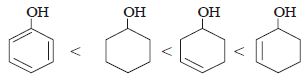
Assertion : The ease of dehydration of the following alcohols is

Reason : Alcohols leading to conjugated alkenes are dehydrated to a greater extent

Normal boiling point of water is $373\,K$  (at $760\,mm$ ). Vapour pressure of water at $298\,K$ is $23\,mm$. If the enthalpy of evaporation is  $40.656\,kJ/mole$, the boiling point of water at $ 23\,mm$ pressure will be ............. $\mathrm{K}$
$17.4\%\, (mass / volume)\, K_2SO_4$ solution at $27\,^oC$ is isotonic to $5.85\%\, (mass / volume)\, NaCl$ solution at $27\,^oC$ . If $NaCl$ is $100\%$ ionised, what is $\%$ ionisation of $K_2SO_4$ in aq. solution ? [At wt. of $K = 39,\, Na = 23$  ]
What will be the reduction product of following reactions :

$CHC{l_3}\,\xrightarrow[{Zn/HCl\,\,(alc.)}]{{ +\, 2H}}$

$CHC{l_3}\,\xrightarrow[{Zn/HCl\,\,(aq)}]{{ + \,4H}}$

$CHC{l_3}\,\xrightarrow[{Zn/{H_2}O}]{{ + \,6H}}$

The following reagent converts ${C_6}{H_5}COCHO$ to ${C_6}{H_5}CHOHCOONa$
The total number of acidic oxides from the following list is: $NO , N _{2} O , B _{2} O _{3}, N _{2} O _{5}, CO$, $SO _{3}, P _{4} O _{10}$
Chloropicrin is obtained by the reaction of
What will be the reduction potential of $Cu$ in aqueous solution with $pH = 12$ ? If $K_{sp}$ of $Cu(OH)_2$ is $1\times10^{-19}$ and $E_{C{u^{ + 2}}/Cu}^o = 0.34\,V$ ............. $\mathrm{V}$