Question
An aeroplane travels over a rectangular field 100m × 50m, parallel to its length. What should be the speed of the plane so that the field becomes square in the plane frame?

Answer

The rectangular field appears to be a square when the length becomes equal to the breadth i.e. 50m.
i.e. $\text{L}'=50;\ \text{L}=100 ;\ \text{v}={?}$
$\text{C} = 3 \times10^8\text{m/s}$
We know, $\text{L}'=\text{L}\sqrt{1-\frac{\text{v}^2}{\text{c}^2}}$
$\Rightarrow50=100\sqrt{1-\frac{\text{v}^2}{\text{c}^2}}$
$\Rightarrow\text{v}=\sqrt{\frac{3}{2\text{c}}}=0.866\text{c}$

Need a full question paper?

Generate a complete, print-ready paper with questions like this in minutes — across 16+ boards, with answer keys.
Start Generating Free

Similar questions

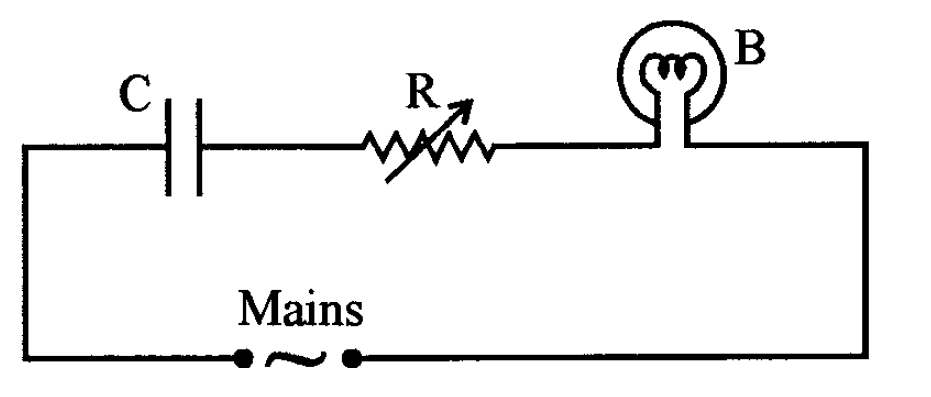
A capacitor'C', a variable resistor 'R' and a bulb oB' are connected in series to the ac mains in circuit as shown. The bulb glows with some brightness. How will the glow of the bulb change if (i) a dielectric slab is introduced between the plates of the capacitor, keeping resistance R to be the same; (ii) the resistance R is increased keeping the same capacitance?  
What is the importance of radial magnetic field in a moving coil galvanometer ?
A force F = a + bx acts on a particle in the x-direction, where a and b are constants. Find the work done by this force during a displacement from x = 0 to x = d.
The distance of the field point on the axis of a small dipole is doubled. By what factor will the electric field, due to the dipole change?
A cylindrical surface of radius $r$ and length $l$ contains a thin, straight conducting wire of charge density $\lambda$ of infinite length. The axis of the cylindrical surface coincides with the length of the wire. Find the expression for electric flux through a cylindrical surface.
Distinguish between 'intrinsic' and 'extrinsic' semiconductors.
How much positive and negative charge is there in a cup of water?
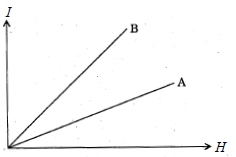
The following figure shows the variation of intensity of magnetisation versus the applied magnetic field intensity, H, for two magnetic materials A and B:
  1. Identify the materials A and B.
  2. Why does the material B, have a larger susceptibility than A, for a given field at constant temperature?
The angle made by the string of a simple pendulum with the vertical depends on time as $\theta=\frac{\pi}{90}\sin[(\pi\text{s}^{-1})\text{t}].$ Find the length of the pendulum if $\text{g}=\pi^2\text{m/s}^2.$
When can the internal resistance of the cell can be neglected? Derive the formula for the current when cell is connected to the external resistance $R$.