Question
An $ \alpha $-particle and a proton are accelerated through the same potential difference. Find the ratio of their de-Broglie wavelength.

Answer

$ \lambda=\frac{h}{p}\Rightarrow\lambda=\frac{h}{\sqrt{2mE}} $ or $ \lambda=\frac{h}{\sqrt{2mqV}} $
$\therefore \quad \frac{\lambda_\alpha}{\lambda_p}=\frac{h / \sqrt{2 m_\alpha \cdot q_\alpha V }}{h / \sqrt{2 m_p q_p \cdot V}}=\sqrt{\left(\frac{m_p}{m_\alpha}\right)\left(\frac{q_p}{q_\alpha}\right)}$
$ =\sqrt{(\frac{m_{p}}{4m_{p}})(\frac{q_{p}}{2q_{p}})}=\sqrt{(\frac{1}{8})} $
$\Rightarrow \quad \lambda_\alpha: \lambda_p=1: \sqrt{8}$ or $\lambda_\alpha: \lambda_p=1: 2 \sqrt{2}$

Need a full question paper?

Generate a complete, print-ready paper with questions like this in minutes — across 16+ boards, with answer keys.
Start Generating Free

Similar questions

Calculate the mass of an $\alpha$-particle. Its binding energy is 28.2MeV.
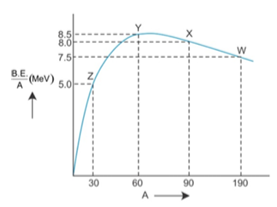
Binding energy per nucleon vs mass number curve for nuclei is shown in the figure. W, X, Y and Z are four nuclei indicated on the curve. Identify which of the following nuclei is most likely to undergo
(i) Nuclear Fission
(ii) Nuclear Fusion.
Justify your answer.

Image
A block of mass m moving at a speed v compresses a spring through a distance x before its speed is halved. Find the spring constant of the spring.
Answer the following question:
As you have learnt in the text, the principle of linear superposition of wave displacement is basic to understanding intensity distributions in diffraction and interference patterns. What is the justification of this principle?
Suppose you are given a chance to repeat the alpha-particle scattering experiment using a thin sheet of solid hydrogen in place of the gold foil. (Hydrogen is a solid at temperatures below 14 K). What results do you expect?
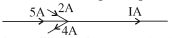
Write Kirchhoff's junction rule. Write the magnitude of current $I$ in the given figure.
Image
A disc rotates about its axis with a constant angular acceleration of 4rad/s2. Find the radial and tangential accelerations of a particle at a distance of 1cm from the axis at the end of the first second after the disc starts rotating.
Answer the following question:
The angle subtended at the eye by an object is equal to the angle subtended at the eye by the virtual image produced by a magnifying glass. In what sense then does a magnifying glass provide angular magnification?
Define the term 'Half-life' of a radioactive substance. Two different radioactive substances have half-lives $T _1$ and $T _2$ and number of undecayed atoms at an instant, $N _1$ and $N _2$, respectively. Find the ratio of their activities at that instant.
Radioactive 131I has a half-life of 8.0 days. A sample containing 131I has activity $20\mu\text{Ci}$ at t = 0.
  1. What is its activity at t = 4 days?
  2. What is its decay constant at t = 4.0 days?