Question
An alternating voltage $E = 200\sqrt 2\, \sin\, (100\,t)$ is connected to a $1$ microfarad capacitor through an ac ammeter. The reading of the ammeter shall be......$mA$

Answer

(b) Reading of ammeter $ = {i_{rms}} = \frac{{{V_{rms}}}}{{{X_C}}} = \frac{{{V_0}\omega C}}{{\sqrt 2 }}$
$ = \frac{{200\sqrt 2 \times 100 \times (1 \times {{10}^{ - 6}})}}{{\sqrt 2 }} = 2 \times {10^{ - 2}}A = 20\;mA$

Need a full question paper?

Generate a complete, print-ready paper with questions like this in minutes — across 16+ boards, with answer keys.

Start Generating Free

Similar questions

Assertion : If the current in a solenoid is reversed in direction while keeping the same magnitude, the magnetic field energy stored in the solenoid remains unchanged.

Reason : Magnetic field energy density is proportional to the magnetic field.
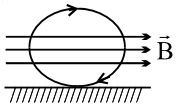
A conducting ring of mass $2\,\, kg$ and radius $0.5\,\ m$ is placed on a smooth horizontal plane. The ring carries a current $i = 4A. A$ horizontal magnetic field $B = 10T$ is switched on at time $t = 0$ as shown in figure. The initial angular acceleration of the ring will be
Hertz is the unit for
A boy sitting on the topmost berth in the compartment of a train which is just going to stop on a railway station, drops an apple aiming at the open hand of his brother sitting vertically below his hands at a distance of about 2 meter. The apple will fall
If $W$ be the weight of a body of density $\rho $ in vacuum then its apparent weight in air of density $\sigma $ is
Which of the adjoining graphs represents ohmic resistance
A source of frequency $f$ is emitting sound waves. If temperature of the medium increases, then
A vector in $x-y$ plane makes an angle of $30^{\circ}$ with $y$-axis The magnitude of $y$-component of vector is $2 \sqrt{3}$. The magnitude of $x$-component of the vector will be
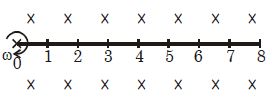
A rod of length $l$ is rotating with constant angular velocity $\omega $ and we marked the rod $0, 1, 2, .......... 8$ at equal spacing. Potential difference between consecutive points, if we go from left to right will be 
If two charges $q _1$ and $q _2$ are separated with distance ' $d$ ' and placed in a medium of dielectric constant $K$. What will be the equivalent distance between charges in air for the same electrostatic force?