MCQ
An alternation in the base sequence of nucleic acid molecule is called
- AReplication
- ✓Mutation
- CDuplication
- DDislocation
Generate a complete, print-ready paper with questions like this in minutes — across 16+ boards, with answer keys.
$\mathrm{Pt}(s) \mid \mathrm{H}_2(g, 1 \text { bar })\left|\mathrm{H}^{+}(a q, 1 \mathrm{M}) \| \mathrm{M}^{4+}(a q), \mathrm{M}^{2+}(a q)\right| \mathrm{Pt}(s)$
$E_{\text {cell }}=0.092 \mathrm{~V} \text { when } \frac{\left[\mathrm{M}^{2+}(a q)\right]}{\left[\mathrm{M}^{4+}(a q)\right]}=10^x$
Given : $ E_{\mathrm{M}^4 / \mathrm{M}^{2+}}^0=0.151 \mathrm{~V} ; 2.303 \frac{R T}{F}=0.059 \mathrm{~V}$
The value of $x$ is
(image)
$[A]$ Attractive intermolecular interactions between $L-L$ in pure liquid $L$ and $M-M$ in pure liquid $M$ are stronger than those between $L-M$ when mixed in solution
$[B]$ The point $Z$ represents vapour pressure of pure liquid $M$ and Raoult's law is obeyed when $x_{L} \rightarrow 0$
$[C]$ The point $Z$ represents vapour pressure of pure liquid $L$ and Raoult's law is obeyed when $x_{\mathrm{L}} \rightarrow 1$
$[D]$ The point $Z$ represents vapour pressure of pure liquid $M$ and Raoult's law is obeyed from $x_{L}=0$ to $x_{L}=1$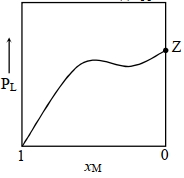
$(I)\,\,[Fe(CN)_6]^{4-}$ $(II)\,\,[Fe(CN)_6]^{3-}$
$(III) [Cr(NH_3)_6]^{3+}$ $(IV)\,\,[Ni(H_2O)_4]^{2+}$