MCQ
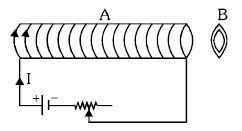
An aluminium ring $B$ faces an electromagnet $A$. The current $I$ through $A$ can be altered. Then which of the following statement is correct
  • A
    If $I$ decreases $A$ will repel $B$
  • B
    Whether $I$ increases or decreases, $B$ will not experience any force
  •  If $I$ increases, $A$ will repel $B$
  • D
    If $I$ increases, $A$ will attract $B$
Answer

Correct option: C.
 If $I$ increases, $A$ will repel $B$
c

Need a full question paper?

Generate a complete, print-ready paper with questions like this in minutes — across 16+ boards, with answer keys.

Start Generating Free

Similar questions

Positive and negative point charges of equal magnitude are kept at $\left(0,0, \frac{a}{2}\right)$ and $\left(0,0, \frac{-a}{2}\right)$, respectively. The work done by the electric field when another positive point charge is moved from $(-a, 0,0)$ to $(0, a, 0)$ is
If $x = a/t + b/{t^2}+c,$, where $x$ is the distance travelled by the body in metres while $t$ is the time in seconds, then the units of $b$ are
A heated body maintained at $T\,K$ emits thermal radiation of total energy $E$ with a maximum intensity at frequency $v$ . The emissivity of the material is $0.5$ . If the temperature of the body be increased and maintained at temperature $3T\,K$ , then

$(i)$ The maximum intensity of the emitted radiation will occur at frequency $v /3$

$(ii)$ The maximum intensity of the emitted radiation will occur at frequency $3v $

$(iii)$ The total energy of emitted radiation will become $81\,E$

$(iv)$ The total energy of emitted radiation will become $27\,E$

A metal rod of Young's modulus $Y$ and coefficient of thermal expansion $\alpha$ is held at its two ends such that its length remains invariant. If its temperature is raised by $t^{\circ} C$, the linear stress developed in it is
If the tension in the string of a sonometer changes by a small amount from T to $T +\Delta$ $T$, the fundamental frequency of vibration changes from $n$ to $n+\Delta n$, then:
The position $x$ of a particle with respect to time $t$ along $x-$axis is given by $x = 9{t^2} - {t^3}$ where $x$ is in metres and $t$ in seconds. What will be the position of this particle when it achieves maximum speed along the $x$ direction ?..........$m$
The ratio of longest wavelength and the shortest wavelength observed in the five spectral series of emission spectrum of hydrogen is
An electric dipole is placed on ${x}$-axis in proximity to a line charge of linear charge density $3.0 \times 10^{-6}\, {C} / {m}$. Line charge is placed on $z-$axis and positive and negative charge of dipole is at a distance of $10\, {mm}$ and $12\, {mm}$ from the origin respectively. If total force of $4\, {N}$ is exerted on the dipole, find out the amount of positive or negative charge of the dipole.
A dipole with an electric moment $\vec{p}$ is located at a distance $r$ from a long thread charged uniformly with a linear charge density $\lambda$. Find the force $F$ acting on the dipole if the vector $\vec{p}$ is oriented along the thread
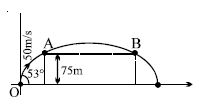
At $t = 0$ a projectile is fired from a point $O$(taken as origin) on the ground with a speed of $50\,\, m/s$ at an angle of $53^o$ with the horizontal. It just passes two points $A \& B$ each at height $75 \,\,m$ above horizontal as shown The distance (in metres) of the particle from origin at $t = 2$ sec.