MCQ
An aqueous solution of ammonia consists of
  • A
    ${H^ + }$
  • B
    $O{H^ - }$
  • C
    $NH_4^ + $
  • $NH_4^ + $ and $O{H^ - }$

Answer

Correct option: D.
$NH_4^ + $ and $O{H^ - }$
(d) ${H_2}O + N{H_3} $ $ \rightleftharpoons $ $N{H_4}^ + + O{H^ - }$

Need a full question paper?

Generate a complete, print-ready paper with questions like this in minutes — across 16+ boards, with answer keys.

Start Generating Free

Similar questions

What will be the oxidation state of Cr in the last compound formed by the reaction of KI and acidic $K _2 Cr _2 O _7$ ?
Assume carbon burns according to following equation :

$2 C _{( s )}+ O _{2( g )} \rightarrow 2 CO ( g )$

When $12\,g$ carbon is burnt in $48\,g$ of oxygen, the volume of carbon monoxide produced is $......\times 10^{-1}\,L$ at STP [nearest integer]

[Given : Assume $CO$ as ideal gas, Mass of $C$ is $12\,g\,mol ^{-1}$, Mass of $O$ is $16\,g\,mol ^{-1}$ and molar volume of an ideal gas at STP is $22.7\,L\, mol ^{-1}$ ]
What will be the molality of the solution containing 18.25g of HCl gas in 500g of water?
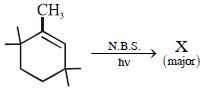
$X$ is
Among the triatomic molecules/ions, $BeCl _2, N _3^{-}, N _2 O , NO _2^{+}, O _3, SCl _2, ICl _2^{-}, I _3^{-}$and $XeF _2$, the total number of linear molecule$(s)$/ion$(s)$ where the hybridization of the central atom does not have contribution from the $d$-orbital(s) is

[Atomic number: $S =16, C 1=17, I =53$ and $Xe =54$ ]
The distance between $3^{rd}$ and $2^{nd}$ Bohr's orbits in the hydrogen atom is
Which of the following exhibit geometrical isomerism?
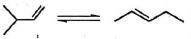
The heat of hydrogenation for $3$ -methylbutene and $2$ -pentene are $-30\, kcal/mol$ and $-28\,kcal/mol$ respectively. The heats of combustion of $2$ -methylbutane and  pentane are - $784 \,kcal / mol$ and $-782 \,kcal/mol$ respectively. All the values are  given under standard conditions. Taking into account that combustion of both alkanes  give the same products, what is $\Delta H$ (in $kcal/mol$) for the following reaction under  same conditions ?
Different hydrogen in the compound are represented by alphabets :
$\mathop {\mathop {C{H_3}}\limits_{(A)}  - CH}\limits_{\,\,\,\,\,\,\,\,\,\,\,\,\,\,\,\,\,\,\,\,\,\,\,\,}  = \mathop {CH}\limits_{(B)}  - \mathop {C{H_2}}\limits_{(C)}  - \mathop {C{H_2}}\limits_{(D)}  - \mathop {CH}\limits_{(E)} \mathop {{{\left( {C{H_3}} \right)}_2}}\limits_{(F)} $
arrange them in decreasing order of reactivity towards free radical substitution
Sodium ethoxide is a specific reagent for