Question
An arbitrary surface encloses a dipole. What is the electric flux through this surface?

Answer

Zero.
According to Gauss, law, the electric flux through an enclosed surface is given by $\oint_\text{s}\overrightarrow{\text{E}}.\text{d}\overrightarrow{\text{S}}=\frac{\text{q}_\text{enclosed}}{\in_0}$
The net charge on a dipole is given by -q + q = 0, hence qenclosed = 0
Hence the electric flux through a surface enclosing dipole $=\frac{\text{-q}+\text{q}}{\in_0}=\frac{\text{q}}{\in_0}=0.$

Need a full question paper?

Generate a complete, print-ready paper with questions like this in minutes — across 16+ boards, with answer keys.
Start Generating Free

Similar questions

How does the angle of minimum deviation of a glass prism vary, if the incident violet light is replaced with red light?
The elastic limit of steel is 8 × 10⁸N/m2 and its Young's modulus 2 x 10¹¹N/m2. Find the maximum elongation of a half meter steel wire that can be given without exceeding the elastic limit.
Which of the following radiations are:
  1. Heat radiation,
  2. Used for long distance transmission? Infrared rays, gamma rays, ultraviolet rays, microwaves.
When light travels from an optically denser medium to a rarer medium, why does the critical angle of incidence depend on the colour of light?
If the ice at the poles melts and flows towards the equator, how will it affect the duration of day-night?
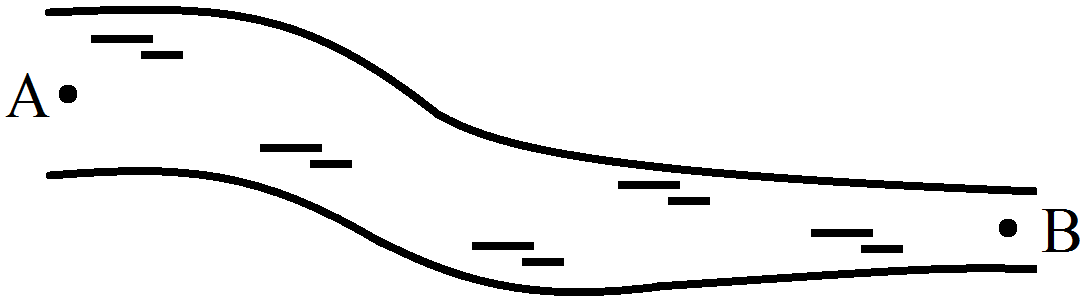
Water flows through a tube shown in The areas of cross-section at A and B are 1cm2 and 0.5cm2 respectively. The height difference between A and B is 5cm. If the speed of water at A is 10cm/s find.
  1. The speed at B.
  2. The difference in pressures at A and B.

Mark the correct statements:
  1. Equations of special relativity are not applicable for small speeds.
  2. Equations of special relativity are applicable for all speeds.
  3. Nonrelativistic equations give exact result for small speeds.
  4. Nonrelativistic equations never give exact result.
A photographic plate placed at a distance of 5cm from a weak point source is exposed for 3s. If the plate is kept at a distance of 10cm from the source, the time needed for the same exposure is:
  1. 3s
  2. 12s
  3. 24s
  4. 48s
Define the unit of electric potential.
A capillary tube of radius 0.50mm is dipped vertically in a pot of water. Find the difference between the pressure of the water in the tube 5.0cm below the surface and the atmospheric pressure. Surface tension of water = 0.075N/m.