Question
An aromatic compound $‘A’$ on heating with $Br_2$ and $KOH$ forms a compound $‘B’$ of molecular formula $C_6H_7N$ which on reacting with $CHCl_3$ and alcoholic $KOH$ produces a foul smelling compound $‘C’.$ Write the structures and IUPAC names of compounds $A, B$ and $C.$
Answer

Get the step-by-step solution for this question inside the Vidyadip app.

Get the answer in the app

Need a full question paper?

Generate a complete, print-ready paper with questions like this in minutes — across 16+ boards, with answer keys.

Start Generating Free

Similar questions

Give reasons :
(i) Carbon-oxygen bond length in phenol is slightly less than that of methanol.
(ii) The $C - O - C$ bond angle present in ether is greater than the tetrahedral angle.
(iii) The boiling point of isomeric alcohols decreases with increase in branching.
Answer the following questions:
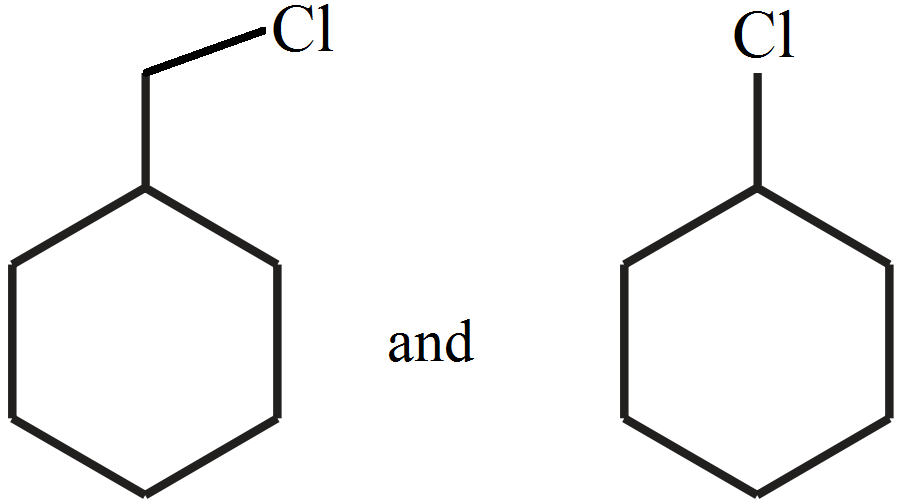
In the following pairs of halogen compounds, which would undergo $S_N1$ reaction faster? Explain.
How the following conversions can be carried out?
i. 2-Bromopropane to 1-bromopropane
ii. Chloroethane to butane
iii. Benzene to diphenyl
Conductivity of saturated solution of $BaSO _4$ at 315 K is $3.648 \times 10^{-6} ohm ^{-1} cm^{-1}$ and that of water is $1.25 \times$ $10^{-6} ohm ^{-1} cm^{-1}$. Ionic conductance of $Ba ^{2+}$ and $SO _4^{2-}$ are $110$ and $136.6 ohm ^{-1} cm^2 mol^{-1}$ respectively. Calculate the solubility of $BaSO _4$ in $g / L$.
Calculate the emf of the following cell at $298 K .$
$\ce{2Cr(s) + 3Fe^{2+}(0.1 M) \rightarrow 2Cr^{3+}(0.01M) + 3Fe(s)}$
Given, $E_{c r^{3+} / c r}^o=-0.74 V, E_{F e^{2+} / F e}^o=-0.44 V$
  1. Name the sweetening agent used in the preparation of sweets for a diabetic patient.
  2. What are antibiotics? Give an example.
  3. Give two examples of macromolecules that are chosen as drug targets.
Calculate the freezing point of solution when $2\ g$ of $Na_2SO_4(M = 142\ g\ mol^{–1})$ was dissolved in $50\ g$ of water, assuming $Na_2SO_4$ undergoes complete ionisation.
$(K_f$ for water $= 1.86\ K\ kg\ mol^{–1})$
i. What type of isomerism is shown by the complex $\left[\mathrm{Co}\left(\mathrm{NH}_3\right)_6\right]\left[\mathrm{Cr}(\mathrm{CN})_6\right]$ ?
ii. Why a solution of $\left[\mathrm{Ni}\left(\mathrm{H}_2 \mathrm{O}\right)_6\right]^{2+}$ is green while a solution of $\left[\mathrm{Ni}(\mathrm{CN})_4\right]^{2-}$ is colourless? (At. no. of $\mathrm{Ni}=28$ )
iii. Write the IUPAC name of the following complex: $\left[\mathrm{Co}\left(\mathrm{NH}_3\right)_5\left(\mathrm{CO}_3\right)\right] \mathrm{Cl}$.
(a) Which is the salt of Mn which is isostructural to $KClO _4$ ?
(b) Explain the structure and magnetic properties of manganese and permanganate ions.
Explain kohlrausch Law with example.