Question
An aromatic compound $‘A’$ on treatment with aqueous ammonia and heating forms compound $‘B’$ which on heating with $Br_2$​​​​​​​ and $KOH$ forms a compound $‘C’$ of molecular formula $C_6H_7N.$ Write the structures and IUPAC names of compounds $A,\ B,\ C.$
Answer

Get the step-by-step solution for this question inside the Vidyadip app.

Get the answer in the app

Need a full question paper?

Generate a complete, print-ready paper with questions like this in minutes — across 16+ boards, with answer keys.

Start Generating Free

Similar questions

Write note on enthalpy of atomization of trasition metals.
Note: In the following questions a statement of assertion followed by a statement of reason is given. Choose the correct answer out of the following choices.
Assertion: $Cu$ is less reactive than hydrogen.
Reason: $\text{E}^{\ominus}_{\text{Cu}^{2+}/\text{Cu}}$ is negative.
Give reason for the following:
Neon is generally used for warning signals.
  1. Why are haloalkanes more reactive towards nucleophilic substitution reactions than haloarenes?
  2. Which one of the following two substances undergoes $S_N1$ reaction faster and why?
Write the names of reagents and equations for the preparation of the following ethers by Williamson’s synthesis:2-Methoxy-2-methylpropane.
An alkene with molecular formula $C _6 H _2$ on ozonolysis gives two different products. One of these gave a positive iodoform test but does not reduced Tollens' reagent. The other product give a positive Tollens' test but does not give iodoform test. What is the name and formula of alkene and its products?
Discuss the reactivity of aldehydes and ketones towards the nucleophilic addition reaction.
Describe how the following conversions can be brought about (any two)?
i. Cyclohexanol to cyclohexan-1-one.
ii. Ethyl benzene to benzoic acid.
iii. Bromobenzene to benzoic acid.
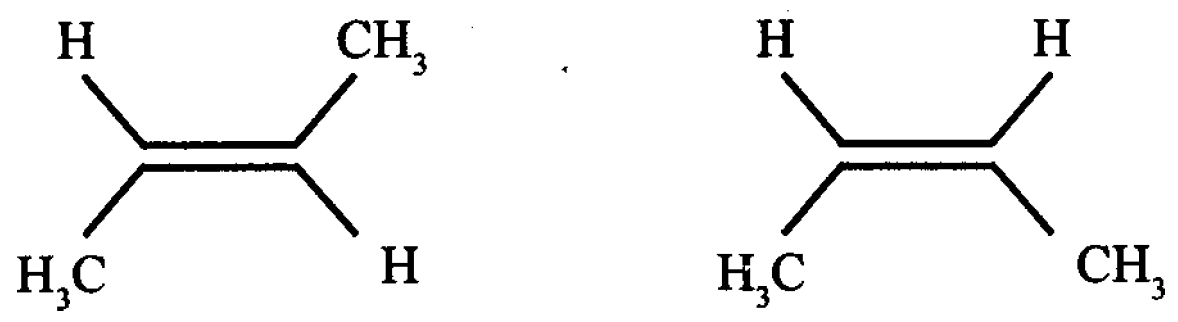
Identify whether the following pairs of compounds are structural or geometrical isomers:
  1.  
  1.  
(i) Complete the following reaction :
$CH _2= CH - CH _2- Br \xrightarrow[\text { Peroxide }]{ HBr }$
(ii) How form n-propyl bromide from isopropyl bromide?