MCQ
An aromatic compounds among other things should have a $\pi $- electron cloud containing electrons where $n$ can't be
  • $0.5$
  • B
    $3$
  • C
    $2$
  • D
    $1$

Answer

Correct option: A.
$0.5$
a
(a) According to Huckel ruel, all aromatic compounds must have $(4n + 2)\pi $ electrons where $n$ is an integer, i.e., $n = 0,\,1,\,2,\,3,\,...$ and possesses unusual stability due to the complete delocalisation of $\pi $- electrons.

Need a full question paper?

Generate a complete, print-ready paper with questions like this in minutes — across 16+ boards, with answer keys.
Start Generating Free

Similar questions

Assertion :A spectral line will be observed for a $2p_x-2p_y$ transition.
Reason : The energy is released in the form of wave of light when electron drops from $2p_x$ to $2p_y$ orbital.
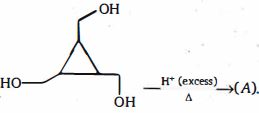
Product $(A)$ is
The values of for the reactions,

$X \rightleftharpoons  Y + Z$        $...(i)$

$A \rightleftharpoons  2B$            $...(ii)$

are in the ratio $9 : 1.$ If degree of dissociation of $X$ and $A$ be equal, then total pressure at equilibrium $(i)$ and $(ii)$ are in the ratio

The second ionization potential of elements is invariable higher than first ionization  potential because
Chlorophyll extracted from the crushed green leaves was dissolved in water to make $2\,L$ solution of $Mg$ of concentration $48\,ppm$. The number of atoms of $Mg$ in this solution is $x \times 10^{20}$ atoms. The value of $x$ is (Nearest Integer) (Given : Atomic mass of $Mg$ is $24\,g\,mol ^{-1}$, $N _{ A }=6.02 \times 10^{23}\,mol ^{-1}$ )
Benzene molecule is
The equilibrium constants of the following are

$N_2 + 3H_2 \rightleftharpoons  2NH_3 \,;$        $K_1$

$N_2 + O_2 \rightleftharpoons  2NO\,;$               $K_2$

$H_2 + 2 O_2 \rightleftharpoons  H_2O\,;$          $K_3$

The equilibrium constant $(K)$ of the reaction :

$2NH_3 + \frac{5}{2} \overset K \leftrightarrows 2NO + 3H_2O$

The total number of electrons involved in the formation of $\ce{CH_4}$​ molecule are :
Colour of acidified $K _2Cr_2O_7$ is not changed by
Why do elements in the same group have similar physical and chemical properties?