MCQ
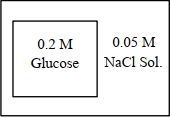
An artificial cell is made by encapsulating $0.2 \mathrm{M}$ glucose solution within a semipermeable membrane. The osmotic pressure developed when the artificial cell is placed within a $0.05 \mathrm{M}$ solution of $\mathrm{NaCl}$ at $300 \mathrm{~K}$ is . . . . . . . . . .$\times 10^{-1}$ bar. (Nearest Integer)

[Given : $\mathrm{R}=0.083 \mathrm{~L} \mathrm{bar} \mathrm{mol}^{-1} \mathrm{~K}^{-1}$ ]

Assume complete dissociation of $\mathrm{NaCl}$

  • A
    $10$
  • B
    $20$
  • $25$
  • D
    $30$

Answer

Correct option: C.
$25$
c
$\mathrm{NaCl} \longrightarrow \mathrm{Na}^{+}+\mathrm{Cl}^{-}$

$0.05 \mathrm{M} \quad 0.05 \mathrm{M} \quad 0.05 \mathrm{M}$

$\text { Total } \mathrm{C}_1=0.05+0.05=0.1 \mathrm{M}(\mathrm{NaCl})$

$\mathrm{C}_2=0.2 \mathrm{M}(\text { glucose })$

$\pi=\left(\mathrm{C}_2-\mathrm{C}_1\right) \mathrm{RT}$

$=(0.2-0.1) \times 0.083 \times 300$

$=2.49 \text { bar }$

$=24.9 \times 10^{-1} \text { bar }$

Need a full question paper?

Generate a complete, print-ready paper with questions like this in minutes — across 16+ boards, with answer keys.

Start Generating Free

Similar questions

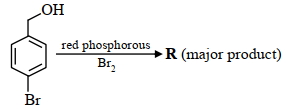
Consider the following reaction. On estimation of bromine in $1.00 g$ of $R$ using Carius method, the amount of $AgBr$ formed (in $g$ ) is. . . .

$\overline{\text { [Given : }}$ Atomic mass of $H =1, C =12, O =16, P =31, Br =80, Ag =108]$

$HI$ cannot be prepared by the action of conc. ${H_2}S{O_4}$ on $KI$ because
The electrons which take part in order to exhibit variable oxidation states by transition metals are
Although Zirconium belongs to $4d$ transition series and Hafnium to $5d$ transition series even then they show similar physical and chemical properties because _____
Concentrated $HNO _{3}$ reacts with Iodine to give
Which occurs in nature in free state
$\alpha -D(+)$ glucose and $\alpha -D(+)$ glucose are

$(i)$ Diastereomers            $(ii)$ Geometrical isomers

$(iii)$ Epimers                    $(iv)$ Anomers

$(v)$ Enantiomers

Compare the  $'x'$  and  $'y'$ bond lengths

$\begin{array}{*{20}{c}}
  {{\mkern 1mu} {\mkern 1mu} {\mkern 1mu} {\mkern 1mu} {\mkern 1mu} {\mkern 1mu} {\mkern 1mu} {\mkern 1mu} {\mkern 1mu} {\mkern 1mu} {\mkern 1mu} {\mkern 1mu} {\mkern 1mu} {\mkern 1mu} {\mkern 1mu} {\mkern 1mu} {\mkern 1mu} {\mkern 1mu} {\mkern 1mu} {\mkern 1mu} {\mkern 1mu} {\mkern 1mu} {\mkern 1mu} {\mkern 1mu} {\mkern 1mu} O\,\,\,\,\,\,{\mkern 1mu} {\mkern 1mu} {\mkern 1mu} {\mkern 1mu} {\mkern 1mu} O{\mkern 1mu} {\mkern 1mu} {\mkern 1mu} {\mkern 1mu} {\mkern 1mu} {\mkern 1mu} {\mkern 1mu} {\mkern 1mu} {\mkern 1mu} {\mkern 1mu} {\mkern 1mu} {\mkern 1mu} {\mkern 1mu} {\mkern 1mu} {\mkern 1mu} {\mkern 1mu} {\mkern 1mu} {\mkern 1mu} {\mkern 1mu} {\mkern 1mu} {\mkern 1mu} } \\ 
  {{\mkern 1mu} {\mkern 1mu} {\mkern 1mu} {\mkern 1mu} {\mkern 1mu} {\mkern 1mu} {\mkern 1mu} {\mkern 1mu} {\mkern 1mu} {\mkern 1mu} {\mkern 1mu} {\mkern 1mu} {\mkern 1mu} {\mkern 1mu} {\mkern 1mu} {\mkern 1mu} {\mkern 1mu} {\mkern 1mu} {\mkern 1mu} ||{\mkern 1mu} {\mkern 1mu} {\mkern 1mu} {\mkern 1mu} \,\,\,\,\,\,\,\,{\mkern 1mu} {\mkern 1mu} {\mkern 1mu} {\mkern 1mu} ||{\mkern 1mu} {\mkern 1mu} {\mkern 1mu} {\mkern 1mu} {\mkern 1mu} {\mkern 1mu} {\mkern 1mu} {\mkern 1mu} {\mkern 1mu} {\mkern 1mu} {\mkern 1mu} {\mkern 1mu} {\mkern 1mu} {\mkern 1mu} {\mkern 1mu} {\mkern 1mu} } \\ 
  {H - O - S\mathop {{\text{ }} - }\limits^x {\mkern 1mu} S - O - H} 
\end{array}$

 $\begin{array}{*{20}{c}}
  {\begin{array}{*{20}{c}}
  {\,\,\,\,\,\,\,\,\,\,\,\,\,\,\,\,\,\,\,\,\,\,\,\,\,\,\,\,\,\,\,\,\,\,\,\,\,\,\,\,\,\,\,O\,\,\,\,\,\,\,\,\,O\,\,\,\,\,} \\ 
  {\,\,\,\,\,\,\,\,\,\,\,\,\,\,\,\,\,\,\,\,\,\,\,\,\,\,\,\,\,\,\,\,\,\,\,\,\,\,\,\,||\,\,\,\,\,\,\,\,\,\,||} 
\end{array}\,\,\,\,\,\,\,\,\,\,\,\,\,\,\,\,\,\,\,\,\,\,\,\,\,\,\,\,\,\,\,\,\,\,\,\,\,\,\,\,} \\ 
  {HO - S\mathop - \limits^y S - OH} \\ 
  {\,\,\,\,\,||\,\,\,\,\,\,\,\,\,\,\,\,\,} \\ 
  {\,\,\,\,\,O\,\,\,\,\,\,\,\,\,\,\,} 
\end{array}$
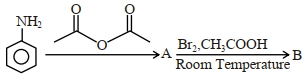
The major products $\mathrm{A}$ and $\mathrm{B}$ formed in the following reaction sequence are :
Amalgams are