MCQ
An artificial satellite is placed into a circular orbit around earth at such a height that it always remains above a definite place on the surface of earth. Its height from the surface of earth is  ........... $km$
  • A
    $6400$
  • B
    $4800$
  • C
    $32000$
  • $36000$

Answer

Correct option: D.
$36000$
d
As the satellite always remains stationary $w.r.t$ earth surface, thus its time period revolution is equal to time period of rotation of earth i.e $24\, hrs$

Time period of satellite $T=2 \pi \sqrt{\frac{r^{3}}{g R^{2}}}$ where $R=6400 \mathrm{km}=6.4 \times 10^{6} \mathrm{m}$

$\therefore 24 \times 3600=2 \pi \sqrt{\frac{r^{3}}{9.8\left(6.4 \times 10^{6}\right)^{2}}}$

OR $\frac{r^{3}}{401.408 \times 10^{12}}=1.89 \times 10^{8} \quad \Longrightarrow r^{3}=76 \times 10^{21}$

$\Rightarrow r=42400 \mathrm{km}$

Thus height of satellite above earth surface $\quad h=42400-6400=36000 \mathrm{km}$

Need a full question paper?

Generate a complete, print-ready paper with questions like this in minutes — across 16+ boards, with answer keys.

Start Generating Free

Similar questions

A planet is revolving around the sun in a circular orbit with a radius $r$. The time period is $T$. If the force between the planet and star is proportional to $r^{-3 / 2}$, then the square of time period is proportional to
If $P$ represents radiation pressure, $c$ represents speed of light and $Q$ represents radiation energy striking a unit area per second, then non-zero integers $x,\,y$ and $z$ such that ${P^x}{Q^y}{c^z}$ is dimensionless, are
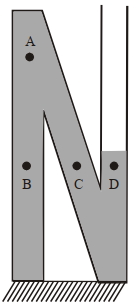
Consider a mercury-filled tube as shown in the figure below 

Which of the following options about the pressures at the lettered locations $(A, B, C, D)$ is true?

A particle of mass $0.01 \;kg$ travels with velocity given by $4 \hat{ i }+16 \hat{ k } \;ms ^{-1}$. After sometime, its velocity becomes $8 \hat{ i }+20 \hat{ j }\;ms ^{-1}$. The work done on particle during this interval of time is ...... $J$
A man can jump to a height of $1.5 \,m$ on a planet $A$. What is the height he may be able to jump on another planet whose density and radius are, respectively, one-quarter and one-third that of planet $A$ .......  $m$
A simple harmonic motion is represented by $F(t) = 10\sin \,(20\,t + 0.5)$. The amplitude of the $S.H.M.$ is  $a$ $=$ .... 
A particle of mass $m$ is projected with velocity $v$ making an angle of ${45^o}$with the horizontal. The magnitude of the angular momentum of the particle about the point of projection when the particle is at its maximum height is (where $g = $ acceleration due to gravity)
A unit mass of solid converted to liquid at its melting point. Heat is required for this process is:
Radius of gyration of a body depends on
A juggler maintains four ball in vertically upward motion. He attempts next ball after $1/4\, sec$. For the shows to go on, what should be the height for which he throws the ball ?.........$m$ $(g=10\,m/s^2)$