Question
An astronaut inside a small spaceship orbiting around the earth cannot detect gravity. If the space station orbiting around the earth has a large size, can he hope to detect gravity?

Answer

Astronaut inside a small spaceship experience a very small negligible constant acceleration and hence astronaut feel weight less ness. If the space station has too much large mass and size then he can only experience acceleration due to gravity in the proximity of moon or on the moon.

Need a full question paper?

Generate a complete, print-ready paper with questions like this in minutes — across 16+ boards, with answer keys.
Start Generating Free

Similar questions

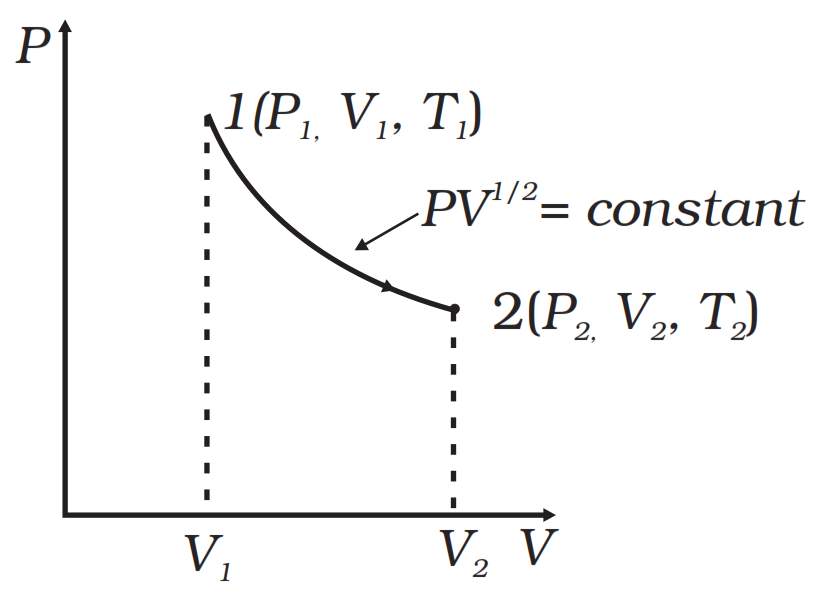
Consider a P-V diagram in which the path followed by one mole of perfect gas in a cylindrical container is shown in Fig. What is the ratio of temperature $\frac{\text{T}_1}{\text{T}_2},\text{if}\text{V}_2=2\text{V}_1?$
The relation between the position and time of a particle under the influence of constant force is $x$ $=(t-4)^2$, where $x$ is in meters and $t$ is in seconds. Then calculate the work done by force in the first 8 seconds.
If the displacement of a body is zero, is distance necessarily zero? Answer with one example.
A soap film of thickness 0.0011mm appears dark when seen by the reflected light of wavelength 580nm. What is the index of refraction of the soap solution, if it is known to be between 1.2 and 1.5?
We can order events in time and there is no sense of time, distinguishing past, present and future. Is time a vector?
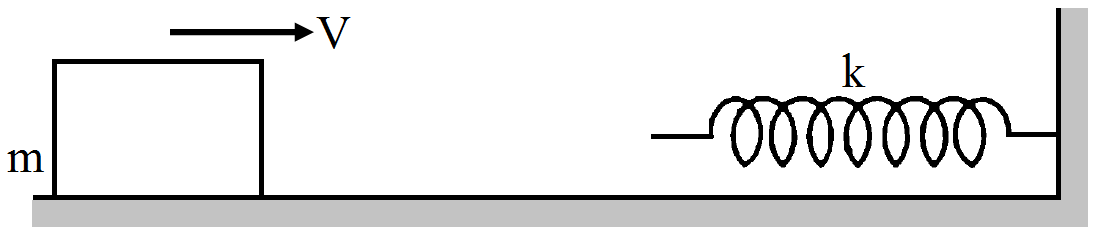
A block of massip, sliding on a smooth horizontal surface with a velocity $\vec{\text{v}}$ meets a long horizontal spring fixed at one end and having spring constant k as shown in figure. Find the maximum compression of tin spring. Will the velocity of the block be the same $\vec{\text{v}}$ when it comes back to the original position shown?
Explain, why it is not possible to increase the temperature of a gas while keeping its volume and pressure constant?
The force with which the earth attracts an object is called the weight of the object. Calculate the weight of the moon from the following data: The universal constant of gravitation $G=6.67 \times 10^{-11} \mathrm{~N}-\mathrm{m}^2 / \mathrm{kg}^2$, mass of the moon $=7.36 \times$ $10^{22} \mathrm{~kg}$, mass of the earth $=6 \times 10^{24} \mathrm{~kg}$ and the distance between the earth and the moon $=3.8 \times 10^5 \mathrm{~km}$.
Explain how an object could have zero average velocity but non-zero average speed?
Electrons are emitted from an electron gun at almost zero velocity and are accelerated by an electric field E through a distance of 1.0m. The electrons are now scattered by an atomic hydrogen sample in ground state. What should be the minimum value of E so that red light of wavelength 656.3nm may be emitted by the hydrogen?