Question
An atom X has 4 protons and 5 neutrons with electronic configuration 2, 2. Give information about its.
  1. Atomic number.
  2. Mass number.
  3. Valency.

Answer

Protons = 4Neutrons = 5
Number of protons = Number of electrons
Number of electrons = 4
Electronic Configuration
= 2, 2
Number of Valence electrons in the outermost shell = 2
Valency = 2
  1. Since, protons =electrons = atomic no. 
So atomic no. is 4
  1. Mass Number = No. of Protons + No. of Neutrons
= 4 + 5 = 9
  1. Now electronic distribution, K = 2, L = 2
So as the outermost shell has 2 electrons, so the valency will be 2

Need a full question paper?

Generate a complete, print-ready paper with questions like this in minutes — across 16+ boards, with answer keys.
Start Generating Free

Similar questions

Alka was making tea in a kettle. Suddenly she felt intense heat from the puff of steam gushing out of the spout of the kettle. She wondered whether the temperature of the steam was higher than that of the water boiling in the kettle. Comment.
What purpose does animal husbandry fulfills?
Give reason for the following:
In most of the cases, we cannot see the vibrations of a sound producing object with our eyes.
Four men lift a $250\ kg$ box to a height of $1m$ and hold it without raising or lowering it.
$(a)$ How much work is done by the men in lifting the box?
$(b)$ How much work do they do in just holding it?
$(c)$ Why do they get tired while holding it? $(g = 10ms^{-2})$
What is neuron? Define it?
A solution contains 50mL of alcohol mixed with 150mL of water. Calculate the concentration of this solution.
The substance X normally exists in a physical state which can flow easily but does not fill its vessel completely. It also turns anhydrous copper sulphate blue. When substance X is cooled excessively, it changes into a substance Y which has a fixed shape as well as a fixed volume. If, however, the substance X is heated strongly, it changes into a substance Z which has neither a fixed shape nor a fixed volume.
  1. Name the substances (i) X (ii) Y and (iii) Z.
  2. What is the process of conversion of X into Y known as?
  3. At which temperature X gets converted into Y?
  4. What is the process of conversion of X into Z known as?
  5. At which temperature X gets converted into Z?
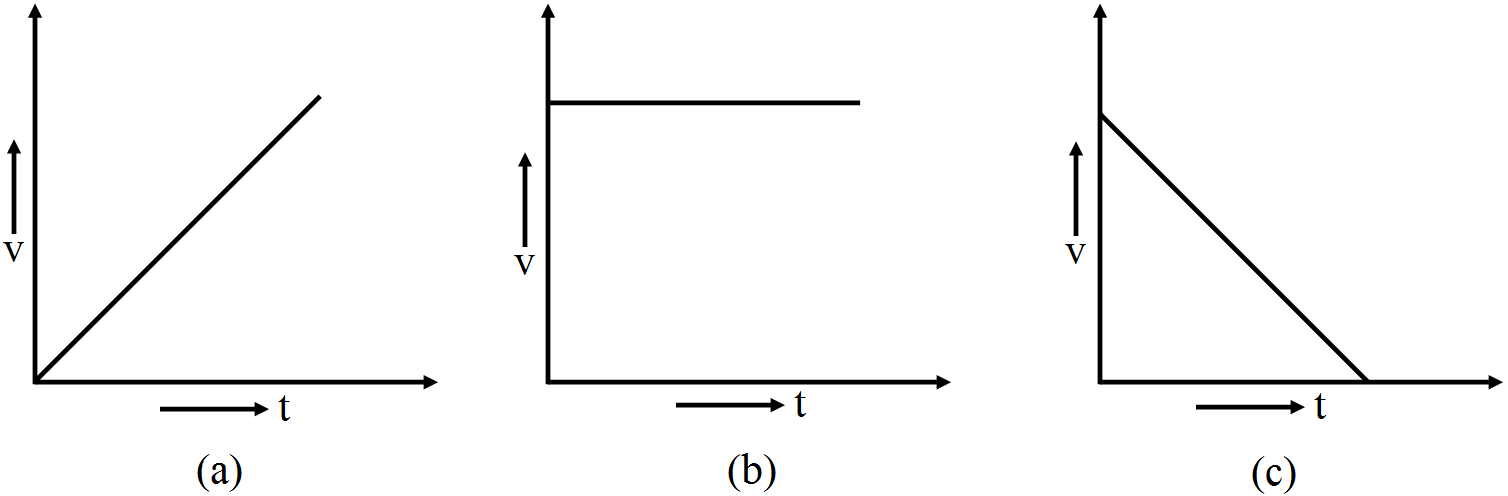
Observe the following v-t graphs and explain the type of force acting in the cases given:
Write down about location, structure and functions of parenchyma.
The weight of a person on a planet A is about half that on the earth. He can jump upto 0.4m height on the surface of the earth. How high he can jump on the planet A?