An electric bulb is rated $60\,W$, $220\,V$. The resistance of its filament is ............. $\Omega$
AIPMT 1994, Easy


Download our appand get started for free
Experience the future of education. Simply download our apps or reach out to us for more information. Let's shape the future of learning together!No signup needed.*
Similar Questions
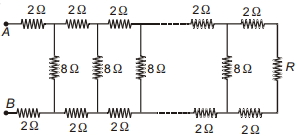
- 1Consider the ladder network shown in figure. What should be the value of resistance $R$, so that effective resistance between $A$ and $B$ becomes independent of number of elements in the combination is ............. $\Omega$View Solution
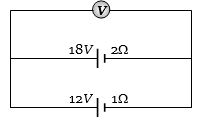
- 2Two batteries, one of emf $18\,volts\;emf$ and internal resistance $2\,\Omega $ and the other of emf $12\, volt$ and internal resistance $1\,\Omega $, are connected as shown. The voltmeter $V$ will record a reading of .............. $volt$View Solution
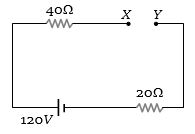
- 3Potential difference across the $40\,\Omega $ resistance will be ............ $V$View Solution
- 4A steady current $i$ is flowing through a conductor of uniform cross-section. Any segment of the conductor hasView Solution
- 5An electric bulb is designed to draw power $P_0$ at voltage $V_0$. If the voltage is $V$ it draws a power $P$. ThenView Solution
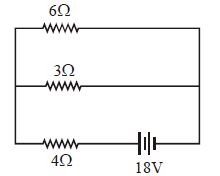
- 6The total power dissipated in watts in the circuit shown is ............. $W$View Solution
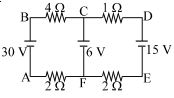
- 7The figure shows a network of four resistances and three batteries The current through the branch $CF$ is ............... $A$View Solution
- 8$n$ equal cell having emf $E$ and internal resistance $r$, are connected in a circuit of a resistance $R$ . Same current flows in circuit either they are connected in series or parallel, ifView Solution
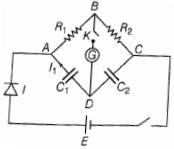
- 9ln the circuit in the figure, if no current flows through the galvanometer when the key $K$ is closed, the bridge is balanced. The balancing condition for bridge isView Solution
- 10View SolutionWhen a potential difference is applied across the ends of a linear metallic conductor