An electric bulb of $500 \,watt$ at $100\, volt$ is used in a circuit having a $200\, {V}$ supply. Calculate the resistance ${R}$ to be connected in series with the bulb so that the power delivered by the bulb is $500\, {W}$. (in $\Omega$)
JEE MAIN 2021, Medium
Download our app for free and get started
${P}={Vi}$
$500={Vi}$
${i}=5 {Amp}$
${V}={i} \times {R}$
${R}=20$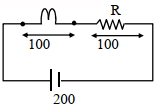

Download our appand get started for free
Experience the future of education. Simply download our apps or reach out to us for more information. Let's shape the future of learning together!No signup needed.*
Similar Questions
- 1When a current of $2\, A$ flows in a battery from negative to positive terminal, the potential difference across it is $12\, V$. If a current of $3 \,A$ flows in the opposite direction potential difference across the terminals of the battery is $15\, V$, the $emf$ of the battery is ................ $\mathrm{V}$View Solution
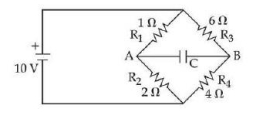
- 2The charge accumulated on the capacitor connected in the following circuit is________ $\mu \mathrm{C}$ (Given $\mathrm{C}=150\ \mu \mathrm{F}$ )View Solution
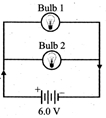
- 3A $6.0\,volt$ battery is connected to two light bulbs as shown in figure. Light bulb $1$ has resistance $3\,ohm$ while light bulb $2$ has resistance $6\,ohm.$ Battery has negligible internal resistance. Which bulb will glow brighter?View Solution
- 4View SolutionA steady current flows in a metallic conductor of non-uniform cross-section. The quantity/quantities constant along the length of the conductor is/are
- 5For a cell terminal $P.D.$ is $2.2\;V$ when circuit is open and reduces to $1.8\;V$ when cell is connected to a resistance of $R = 5\,\Omega $. Determine internal resistance of cell $(r)$ is then ........ $\Omega$View Solution
- 6The charge flowing through a resistance $R$ varies with time $t$ as $ Q=at-bt^2 $ where $a$ and $b$ are positive constants . The total heat produced in $R$ isView Solution
- 7Two heaters $A$ and $B$ have power rating of $1 \mathrm{~kW}$ and $2 \mathrm{~kW}$, respectively. Those two are first connected in series and then in parallel to a fixed power source. The ratio of power outputs for these two cases is:View Solution
- 8View SolutionWhich of the following is not a correct statement
- 9In an electric heater $4\, amp$ current passes for $1$ minute at potential difference of $250\, volt$, the power of heater and energy consumed will be respectivelyView Solution
- 10A potential $V_0$ is applied across a uniform wire of resistance $R$. The power dissipation is $P_1$. The wire is then cut into two equal halves and a potential of $V _0$ is applied across the length of each half. The total power dissipation across two wires is $P_2$. The ratio $P_2: P_1$ is $\sqrt{x}: 1$. The value of $x$ is $.............$.View Solution