Question
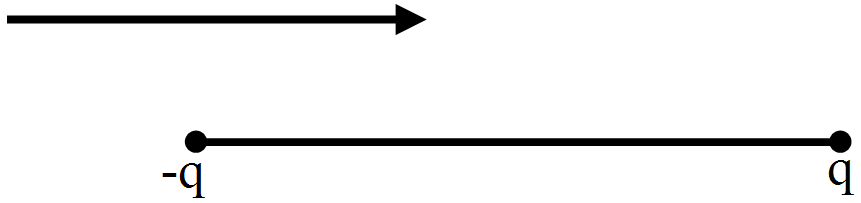
An electric dipole is placed in an electric field generated by a point charge.

Answer

  1. The torque on the dipole due to the field may be zero.
Explanation:
In the uniform Electric field the net electric force on the dipole is alwas zero.

In uniform Electric field the torque on the dipole due to field may be zero.

T = 0
Here t Þ Torque
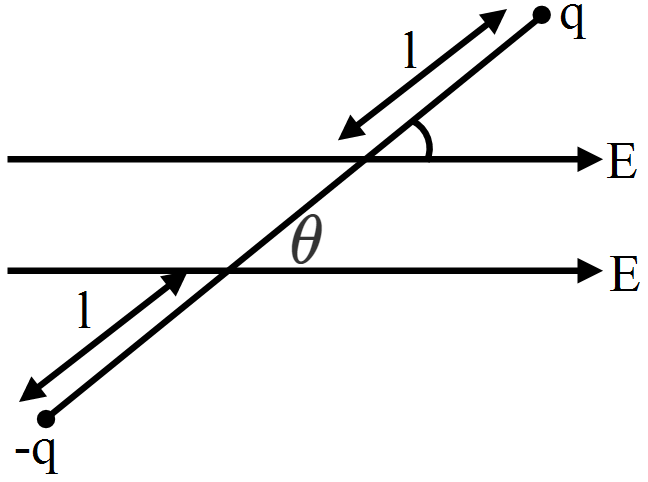
$\text{T}=2\text{qEl}\sin\text{q }\otimes\neq0$

Need a full question paper?

Generate a complete, print-ready paper with questions like this in minutes — across 16+ boards, with answer keys.
Start Generating Free

Similar questions

Two plane mirrors are inclined at an angle of 72° . The number of images of a point object placed between them will be(a) 2(b) 3(c) 4(d) 5
       
A wire carrying current $i$ is shaped as shown. Section $AB$ is a quarter circle of radius $r.$ The magnetic field is directed
Which of the following is correct for resistance of a material ?
Assertion  :  In Young’s experiment, the fringe width for dark fringes is different from that for white fringes.
Reason      : In Young’s double slit experiment the fringes are performed with a source of white light, then only black and bright fringes are observed.(a) If both assertion and reason are true and the reason is the correct explanation of the assertion.(b) If both assertion and reason are true but reason is not the correct explanation of the assertion.(c) If assertion is true but reason is false.(d) If the assertion and reason both are false.


Consider an extended object immersed in water contained in a plane trough. When seen from close to the edge of the trough the object looks distorted because:
In physics, chemistry, and electronic engineering, _______________ is the lack of an electron at a position where one could exist in an atom or atomic lattice.
Out of radioactive radiation which has highest penetrating power ?
The threshold wavelength for photoelectric effect of a metal is 6500 Å. The work function of the metal is approximately(a) 2 eV(b) 1 eV(c) 0.1 eV  (d) 3 eV
       
Consider a planet moving in an elliptical orbit round the sun. The work done on the planet by the gravitational force of the sun:
  1. Is zero in any small part of the orbit.
  2. Is zero in some parts of the orbit.
  3. Is zero in one complete revolution.
  4. Is zero in no part of the motion.
An electric bulb marked 40 W and 200 V, is used in a circuit of supply voltage 100 V. Now its power is(a) 100W(b) 40W(c) 20W   (d) 10W