Answer

  1. The torque on the dipole due to the field may be zero.

Explanation:

In the uniform Electric field the net electric force on the dipole is alwas zero.
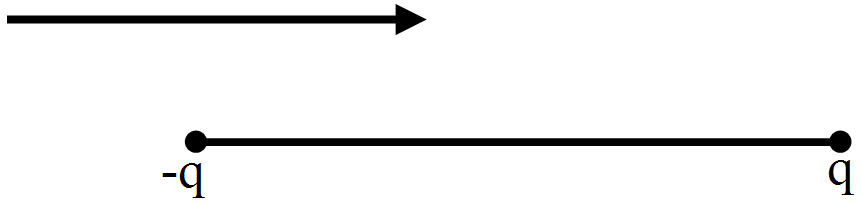
In uniform Electric field the torque on the dipole due to field may be zero.
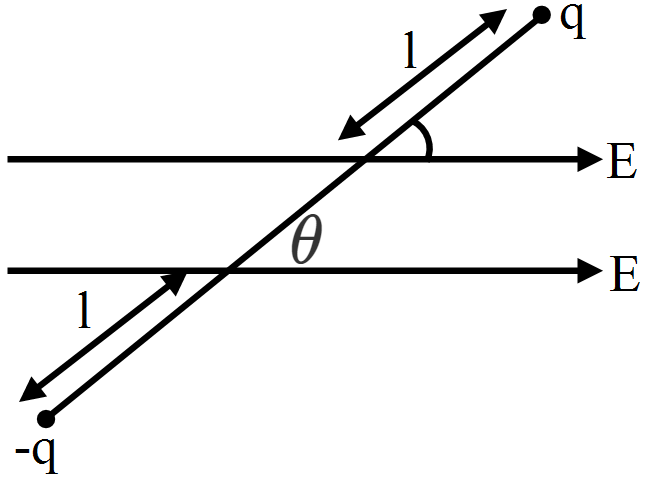
T = 0

Here t Þ Torque

$\text{T}=2\text{qEl}\sin\text{q }\otimes\neq0$

Need a full question paper?

Generate a complete, print-ready paper with questions like this in minutes — across 16+ boards, with answer keys.

Start Generating Free

Similar questions

Two uniform solid spheres having unequal masses and unequal radii are released from rest from the same height on a rough incline. If the spheres roll without slipping:
  1. The heavier sphere reaches the bottom first.
  2. The bigger sphere reaches the bottom first.
  3. The two spheres reach the bottom together.
  4. The information given is not sufficient to tell which sphere will reach the bottom first.
Three waves are given below. I. Sound waves, II. Visible light waves, III. X-rays. Which of the above waves cannot be polarised?
The electric potential decreases uniformly from 120V to 80V as one moves on the x-axis from x = -1cm to x = + 1cm. The electric field at the origin.

A radioactive nucleus  decays to  . Which of the following particles are emitted

(a) One alpha and one electron      

(b) Two deuterons and one positron

(c) One alpha and one proton

(d) One proton and four neutrons

The resistivity of a wire varies with:

A cable of resistance 10 Ω carries electric power from a generator producing 250 kW at 10000 volt. The current in the cable is

(a) 25 A   

(b) 250 A


(c) 100 A 

(d) 1000 A

Let there be a spherically symmetric charge distribution with charge density varying as $\text{p}(\text{r})=\text{p}_0\bigg(\frac{5}{4}-\frac{\text{r}}{\text{R}}\bigg)$ upto r = R and p(r) = 0 for r > R where r is the distance from the origin the electric field at a distance r(r < R) from the origin is given by.
Wavefront of a wave has direction with wave motion:
Wave front formed by the collimator of a spectrometer:

A semiconductor is cooled from   to  Its resistance

(a) Will decrease

(b) Will increase

(c) Will first decrease and then increase

(d) Will not change