MCQ
An electric dipole placed in a non-uniform electric field can experience
  • A
    always a force and a torque.
  • B
    neither a force nor a torque.
  • C
    a force but not a torque.
  • D
    a torque but not a force.

Answer

(a) always a force and a torque.
Explanation: always a force and a torque.

Need a full question paper?

Generate a complete, print-ready paper with questions like this in minutes — across 16+ boards, with answer keys.
Start Generating Free

Similar questions

If the intensity of the radiation incident on a photo$-$sensitive plate is doubled, how does the stopping potential change?
There are two radionuclei $A$ and $B.$ $A$ is an alpha emitter and $B$ is a beta emitter. Their distintegration constants are in the ratio of $1 : 2.$ What should be the ratio of number of atoms of two at time $t = 0$ so that probabilities of getting $\alpha$ and $\beta$ particles are same at time $t = 0.$
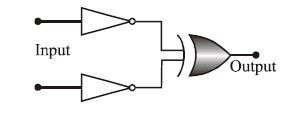
Figure shows a combination of logic gates. To what single gate is this combination equivalent?
Wavelength of light of frequency 100Hz
A current of $2\, amp$. flows in a long, straight wire of radius $2\, mm$. The intensity of magnetic field on the axis of the wire is
If ${l_1},\,{l_2},\,{l_3}$ are the lengths of the emitter, base and collector of a transistor then
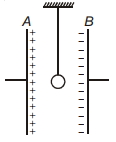
A small conducting sphere is hanged by an insulating thread between the plates of a parallel plate capacitor as shown in figure. The net force on the sphere is
Hydrogen atom emits blue light when it changes from $n = 4$ energy level to the $n = 2$ level. Which colour of light would the atom emit when it changes from the $n = 5$ level to the $n = 2$ level
Two identical radiators have a separation of $d = \lambda /4$ where $\lambda $ is the wavelength of the waves emitted by either source. The initial phase difference between the sources is $\pi /4.$ Then the intensity on the screen at a distant point situated at an angle $\theta = 30^\circ $ from the radiators is (here ${I_o}$ is intensity at that point due to one radiator alone)
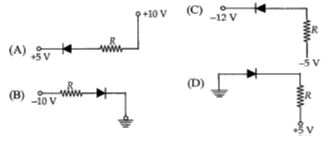
In the following figure, the diodes which are forward biased, are