Question
An electric heater is heated by de and ac respec- tively. The potential difference applied across the ends of heater for both ac and de is same. Heat gener- ated per second will be more:

Answer

(c)Same in both

Need a full question paper?

Generate a complete, print-ready paper with questions like this in minutes — across 16+ boards, with answer keys.
Start Generating Free

Similar questions

How many NAND gates are used to form an AND gate(a) 1 (b) 2(c) 3  (d) 4
       
Resistors of 1, 2, 3 ohm are connected in the form of a triangle. If a 1.5 volt cell of negligible internal resistance is connected across 3 ohm resistor, the current flowing through this resistance will be(a) 0.25 amp(b) 0.5 amp(c) 1.0 amp(d) 1.5 amp
       
A thin convex lens of refractive index 1.5 has a focal length of 15 cm in air. When the lens is placed in liquid of refractive index 4/3 , its focal length will be(a) 15 cm (b) 10 cm(c) 30 cm (d) 60 cm
       
The phenomenon of interference is shown by(a) Longitudinal mechanical waves only(b) Transverse mechanical waves only(c) Electromagnetic waves only(d) All the above types of waves
   
   
Three capacitors of 2.0, 3.0  and  6.0 μF are connected in series to a  10 V  source. The charge on the 3.0 μF  capacitor is(a) 5 μC(b) 10 μC(c) 12 μC(d) 15 μC
       
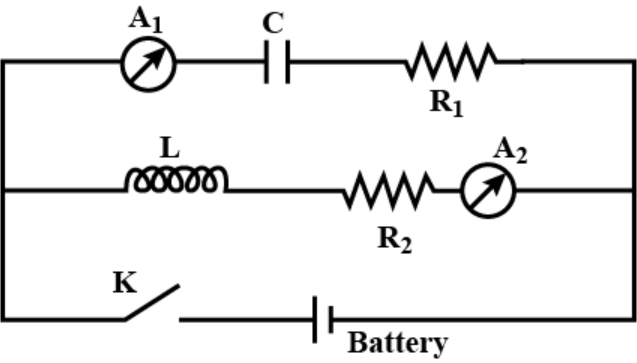
In a circuit inductance $L$ and capacitance $C$ are connected as shown in figure. $A_{1​}$ and $A_2$​ are ammeters.
When key $K$ is pressed to complete the circuit, then just after closing key $(K),$ the readings of $A_{1​ }$ and $A_2$ ​ will be.
Image
Which of the nine planets is nearest to sun (a) Venus                                          (b) Mercury(c) Mars (d) Jupiter
       
A circular loop carrying a current is replaced by ann equivalent magnetic dipole. A point on the axis of the loop is in:
  1. End-on position.
  2. Broadside-on position.
  3. Both.
  4. None.
Faraday’s $2^{nd}$ law states that mass deposited on the electrode is directly proportional to
A photoelectric cell is illuminated by a point source of light 1 m away. When the source is shifted to 2 m then(a) Number of electrons emitted is half the initial number(b) Each emitted electron carries half the initial energy(c) Number of electrons emitted is a quarter of the initial number(d) Each emitted electron carries one quarter of the initial energy