Question
An electric heating element in vacuum is surrounded by a cavity at constant temperature of 227ºC; it consumes 60W of power to maintain a temperature of 727ºC. What is the power consumed by the element to maintain a temperature of 1227º C?

Answer

  1. 320W.

Need a full question paper?

Generate a complete, print-ready paper with questions like this in minutes — across 16+ boards, with answer keys.
Start Generating Free

Similar questions

The activity of a sample of a radioactive material is $A,$ at time $\mathrm{t}_1$ and $\mathrm{A}_2$ at time $\mathrm{t}_2\left(\mathrm{t}_2>\mathrm{t}_1\right)$. If  its mean life $T,$ then
Give the $SI$ unit of magnetic dipole moment.
What should be the shape of a conductor that can hold a charge for long?
A coil with $100$ turns has an inductance of $0.05H$ and $0.02A$ current is passed through it. Flux linked with the coil is
Assertion : The refractive index of diamond is $\sqrt{6}$
and that of liquid is $\sqrt{3}$
If the light travels from diamond to the liquid, it will totally reflected when the angle of incidence is $30^{\circ}$.
Reason : $\mu= \frac{1}{\sin C^{\prime}},$
write $\mu$ is the refractive index of diamond with respect to liquid.
According to Maxwell's hypothesis, changing of electric filed give rise to.
Permanent magnets are made from:
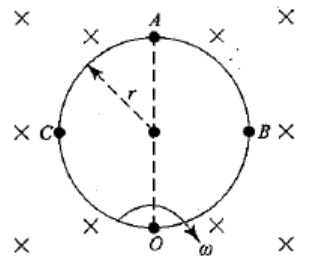
In figure, there is a conducting ring having resistance $R$ placed in the plane of paper in a uniform magnetic field $B_0​$. If the ring is rotating in the plane of paper about an axis passing through point $O$ and perpendicular to the plane of paper with constant angular speed $\omega$ in clockwise direction, then.
Image
When light is refracted into a medium:
  1. Its wavelength and frequency both increase
  2. Its wavelength increases but frequency remains unchanged
  3. Its wavelength decreases but frequency remains unchanged.
  4. Its wavelength and frequency both decrease.
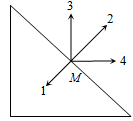
Three identical point charges, as shown are placed at the vertices of an isosceles right angled triangle. Which of the numbered vectors coincides in direction with the electric field at the mid$-$point $M$ of the hypotenuse