MCQ
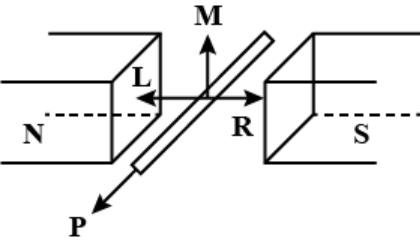
An electric potential difference will be induced between the ends of the conductor shown in the figure, if the conductor moves in the direction shown by:
Image
  • A
    $P$
  • B
    $R$
  • C
    $L$
  • $M$

Answer

Correct option: D.
$M$

Fleming’s Right Hand Rule gives the direction of current in the conductor whenever it is moved in any magnetic field. It states that if we stretch our right hand fingers perpendicular to each other as shown in fig, then if fore finger is in the direction of Magnetic field and thumb is in the direction of motion of conductor then middle finger gives the direction of current in the conductor.
Explanation for the correct answer:
For induction of emf in the conductor, the motion of conductor should be perpendicular to the direction of magnetic field. Thus, Option $B$ and $C$ are eliminated.
Now if we move conductor in $P$ direction, the motion will be perpendicular to the direction of magnetic field but then the charge separation in the conductor will take place perpendicular to the length of the conductor. Thus, due to less space for charge separation emf can not be induced in the conductor. Thus, Option A is eliminated.
If conductor is moved in direction $M$ then the charge separation in the conductor takes place across its length, there will be enough space for charge separation. And thus emf will be induced across the conductor.

Need a full question paper?

Generate a complete, print-ready paper with questions like this in minutes — across 16+ boards, with answer keys.
Start Generating Free

Similar questions

Two parallel wires in free space are 10 cm apart and each carries a current of 10 A in the same direction. The force one wire exerts on the other per metre of length is
A building has two overhead water tanks, each fitted with a sensor $(S_1, S_2)$ which goes to $0$ when the water level in the tank falls below a set value and remains $1$ otherwise. A common pump is used to raise water from an underground storage tank to these overhead tanks. Of the following circuits, which one will turn on $(P =1)$ the pump only when at least one of the tanks have water level below the set value?
A wave moving in a gas,
For the given circuit, comment on the type of transformer used:
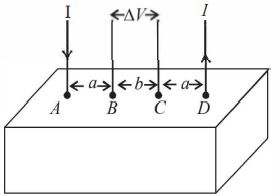
Consider a block of conducting material ofresistivity '$\rho$' shown in the figure. Current '$I$' enters at '$A$' and leaves from '$D$'. We apply superp osition principle to find voltage '$\Delta  V$ ' developed between '$B$' and '$C$'. The calculation is done in the following steps:
$(i)$ Take current '$I$' entering from '$A$' and assume it to spread over a hemispherical surface in the block.
$(ii)$ Calculatefield $E(r)$ at distance '$r$' from $A$ by using Ohm's law $E = \rho  j$, where j is the current per unit area at '$r$'.
(iii) From the '$r$' dependence of $E(r)$, obtain the potential $V(r)$ at $r$.
(iv) Repeat $(i), (ii)$ and $(iii)$ for current '$I$' leaving '$D$' and superpose results for '$A$' and '$D$'.

$\Delta V$ measured between $B$ and $C$ is
Which of the following is correct when one cell is wrongly connected in series circuit?
The process of radioactive radiations remains unaffected due to:
This question has Statement $1$ and Statement $2.$ Of the four choices given after the Statements, choose the one that best describes the two Statements.

Statement $1 :$ The possibility of an electric bulb fusing is higher at the time of switching $ON.$

Statement $2:$ Resistance of an electric bulb when it is not lit up is much smaller than when it is lit up.
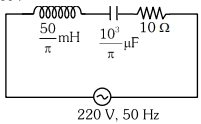
The net impedance of circuit (as shown in figure) will be $...........\,\Omega$
A layer of oil $3\,cm$ thick is floating on a layer of coloured water $5\,cm$ thick. Refractive index of coloured water is $5/3$ and the apparent depth of the two liquids  appears to be $36/7\,cm.$ Find the refractive index of oil.