Question
An electric toaster uses nichrome for its heating element. When a negligibly small current passes through it, its resistance at room temperature $\left(27.0^{\circ} C \right)$ is found to be $75.3 \Omega$. When the toaster is connected to a $230 V$ supply, the current settles, after a few seconds, to a steady value of $2.68 A$. What is the steady temperature of the nichrome element? The temperature coefficient of resistance of nichrome averaged over the temperature range involved, is $1.70 \times 10^{-4}{ }^{\circ} C ^{-1}$.
Answer

When the current through the element is very small, heating effects can be ignored and the temperature $T_1$ of the element is the same as room temperature. When the toaster is connected to the supply, its initial current will be slightly higher than its steady value of $2.68 A$. But due to heating effect of the current, the temperature will rise. This will cause an increase in resistance and a slight decrease in current. In a few seconds, a steady state will be reached when temperature will rise no further, and both the resistance of the element and the current drawn will achieve steady values. The resistance $R_2$ at the steady temperature $T_2$ is
$
R_2=\frac{230 V }{2.68 A }=85.8 \Omega
$
Using the relation
$
R_2=R_1\left[1+\alpha\left(T_2-T_1\right)\right]
$
with $\alpha=1.70 \times 10^{-4}{ }^{\circ} C ^{-1}$, we get
$
T_2-T_1=\frac{(85.8-75.3)}{(75.3) \times 1.70 \times 10^{-4}}=820^{\circ} C
$
that is, $T_2=(820+27.0){ }^{\circ} C =847{ }^{\circ} C$
Thus, the steady temperature of the heating element (when heating effect due to the current equals heat loss to the surroundings) is $847^{\circ} C$.

Need a full question paper?

Generate a complete, print-ready paper with questions like this in minutes — across 16+ boards, with answer keys.

Start Generating Free

Similar questions

A man is sitting on the shore of a river. He is in the line of a 1.0m long boat and is 5.5m away from the centre of the boat. He wishes to throw an apple into the boat. If he can throw the apple only with a speed of 10m/s, find the minimum and maximum angles of projection for successful shot. Assume that the point of projection and the edge of the boat are in the same horizontal level.
Two cells of $\text{EMF} \ 1 V, 2 V$ and internal resistance $2 \Omega$ and $1 \Omega$ respectively are connected in
$i$. series,
$ii$. parallel. What should be the external resistance in the circuit so that the current through the resistance be the same in the two cases? In which case, more heat is generated in the cells?
Draw a graph showing the variation of binding energy per nucleon with mass number of different nuclei. Write any two salient features of the curve. How does this curve explain the release of energy both in the processes of nuclear fission and fusion?
Suppose the glass of the previous problem is covered by a jar and the air inside the jar is completely pumped out.
  1. What will be the answers to the problem?
  2. Show that the answers do not change if a glass of different shape is used provided the height, the bottom area and the volume are unchanged.
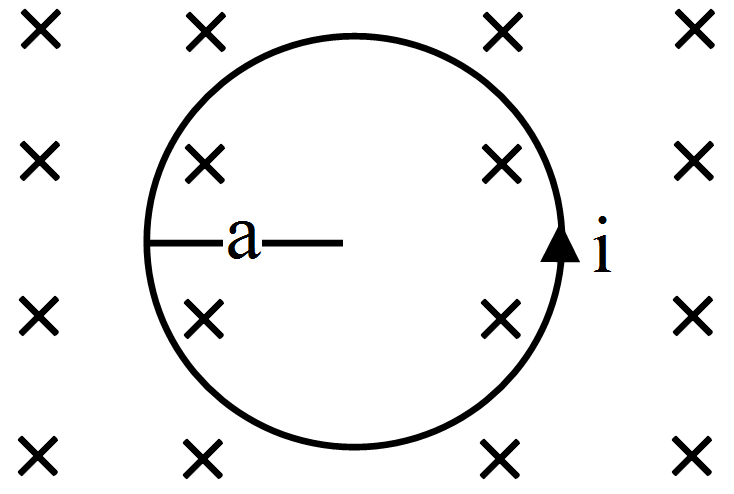
The shows a circular wire loop of radius a and carrying a current i, which is placed in a perpendicular magnetic field B.
  1. Consider a small part dl of the wire. Find the force on this part of the wire exerted by the magnetic field.
  2. Find the force of compression in the wire.
By how much would the stopping potential for a given photosensitive surface go up if the frequency of the incident radiations were to be increased from $4 \times 10^{15}\ Hz$ to $8 \times 10^{15} Hz?$
Given $h = 6.4 \times 10^{-34}$ J-s, e$ = 1.6 \times 10^{-19}C$ and $c = 3 \times 10^8 ms^{-1}.$
A circular loop of radius r carrying a current i is held at the centre of another circular loop of radius R(>> r) carrying a current I. The plane of the smaller loop makes an angle of 30° with that of the larger loop. If the smaller loop is held fixed in this position by applying a single force at a point on its periphery, what would be the minimum magnitude of this force?
A cyclotron’s oscillator frequency is 10 MHz. What should be the operating magnetic field for accelerating protons? If the radius of its ‘dees’ is 60 cm, calculate the kinetic energy (in MeV) of the proton beam produced by the accelerator.
A circular loop of radius r carries a current i. How should a long, straight wire carrying a current 4i be placed in the plane of the circle so that the magnetic field at the centre becomes zero?
Calculate the maximum kinetic energy of the beta particle emitted in the following decay scheme:
$\text{ }^{12}\text{N}\rightarrow{ }^{12}\text{C}^*+\text{e}^++\text{v}$
$\text{ }^{12}\text{C}^*\rightarrow\text{ }^{12}\text{C}+\gamma(4.43\text{MeV}).$
The atomic mass of $^{12}N$ is 12.018613u.