MCQ
An electromagnetic wave can be produced when the charge is
- Amoving in a circular orbit
- Bmoving with a constant velocity
- Cfalling in an electric field
- DBoth (a) and (c)
Explanation:
An accelerated charge is the source of electromagnetic waves (EMWs). When the charge is in a circular motion, the direction of its velocity continuously changes and thus it is in accelerated motion and produces EMWs. A charge falling in an electric field is accelerated by the electric force and thus produces EMWs.
Generate a complete, print-ready paper with questions like this in minutes — across 16+ boards, with answer keys.
Assertion : Magnetic field interacts with a moving charge and not with a stationary charge.
Reason : A moving charge produces a magnetic field.
|
(a) If both assertion and reason are true and the reason is the correct explanation of the assertion. |
|
(b) If both assertion and reason are true but reason is not the correct explanation of the assertion. |
|
(c) If assertion is true but reason is false. |
|
(d) If the assertion and reason both are false. |
A capacitor with air as the dielectric is charged to a potential of 100 volts. If the space between the plates is now filled with a dielectric of dielectric constant 10, the potential difference between the plates will be
|
(a) 1000 volts |
(b) 100 volts |
(c) 10 volts |
(d) Zero |
When a certain length of wire is turned into one circular loop, the magnetic induction at the centre of coil due to some current flowing is  If the same wire is turned into three loops to make a circular coil, the magnetic induction at the center of this coil for the same current will be
|
(a) |
(b) 9 |
(c) 3 |
(d) 27 |
The work done in carrying a charge of 5μC from a point A to a point B in an electric field is 10mJ. The potential difference ( is then
|
(a) + 2kV |
(b) – 2 kV |
(c) + 200 V |
(d) – 200 V |
A metal block is exposed to beams of X-ray of different wavelength. X-rays of which wavelength penetrate most
|
(a) 2 Å |
(b) 4 Å |
(c) 6 Å |
(d) 8 Å |
An equiconvex lens is cut into two halves along (i) XOX¢ and (ii) YOY¢ as shown in the figure. Let f, f ¢, f ¢¢ be the focal lengths of the complete lens, of each half in case (i), and of each half in case (ii), respectively
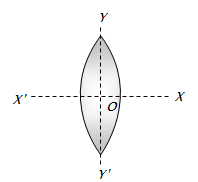
Choose the correct statement from the following
|
(a) |
(b) |
(c) |
(d) |


