MCQ
An electromagnetic waves can be produced, when charge is:
- AMoving with constant velocity
- BMoving in a circular orbit
- CFalling in an electric field
- Dboth (b) and (c)
Explanation:
An accelerated charge is the source of electromagnetic waves (EMWs). When the charge is in a circular motion, the direction of its velocity continuously changes and thus it is in accelerated motion and produces EMWs.
A charge falling in an electric field is accelerated by the electric force and thus produces EMWs.
Generate a complete, print-ready paper with questions like this in minutes — across 16+ boards, with answer keys.
A particle of charge +q and mass m moving under the influence of a uniform electric field  and a uniform magnetic field
  follows trajectory from P to Q as shown in figure. The velocities at P and Q are v
 and -2v
 respectively. Which of the following statement(s) is/are correct

|
(a) E = |
|
(b) Rate of work done by electric field at P is |
|
(c) Rate of work done by both the fields at Q is zero |
|
(d) a, b, c |
A monochromatic beam of light passes from a denser medium into a rarer medium. As a result
|
(a) Its velocity increases |
(b) Its velocity decreases |
|
(c) Its frequency decreases |
(d) Its wavelength decreases |
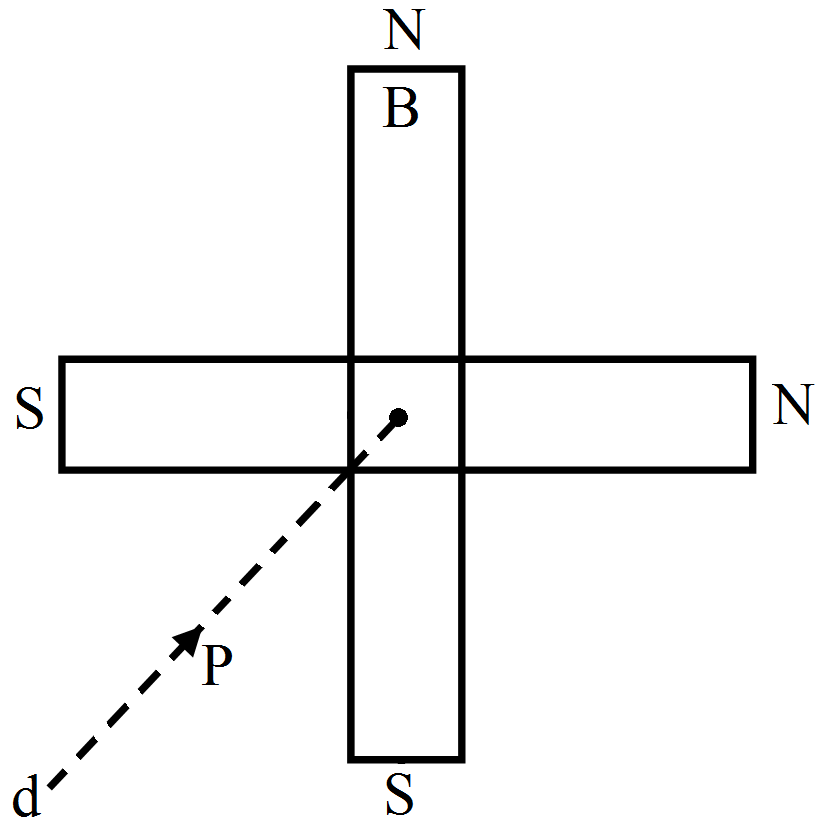
$\frac{\mu_0}{4\pi}\frac{2\text{M}}{\text{d}^3}$
Two concave lenses L1 and L2 are kept in contact with each other. If the space between the two lenses is filled with a material of refractive index $\mu\approx1,$ the magnitude of the focal length of the combination:
Among the following properties describing diamagnetism identify the property that is wrongly stated
|
(a) Diamagnetic material do not have permanent magnetic moment |
|
(b) Diamagnetism is explained in terms of electromagnetic induction |
|
(c) Diamagnetic materials have a small positive susceptibility |
|
(d) The magnetic moment of individual electrons neutralize each other |

