MCQ
An electron accelerated through a potential difference $V$ enters a uniform transverse magnetic field and experiences a force $F$. If the accelerating potential is increased to $2V$, the electron in the same magnetic field will experience a force
  • A
    $F$
  • B
    $\frac{F}{2}$
  • $\sqrt 2 F$
  • D
    $2F$

Answer

Correct option: C.
$\sqrt 2 F$
c
$F=B q v$

But $\frac{1}{2} m v^{2}=e V$ or $v=\sqrt{\frac{2 e V}{m}}$

$\therefore F=B q \sqrt{\frac{2e v}{m}}$

$\Rightarrow F \propto \sqrt{V}$ and

$F \propto \sqrt{2 V}$

$\frac{F^{\prime}}{F}=\sqrt{2}$ or $F^{\prime}=\sqrt{2} F$

Need a full question paper?

Generate a complete, print-ready paper with questions like this in minutes — across 16+ boards, with answer keys.

Start Generating Free

Similar questions

A conducting loop is placed in a uniform magnetic field with its plane perpendicular to the field. An $emf$ is induced in the loop if

$(a)$  It is translated (inside the field)
$(b)$  It is rotated about its axis
$(c)$  It is rotated about a diameter
$(d)$  It is deformed

Identify the wrong statement describing the color code for carbon resistors.
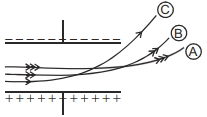
Three particles are projected in a uniform electric field with same velocity perpendicular to the field as shown. Which particle has highest charge to mass ratio?
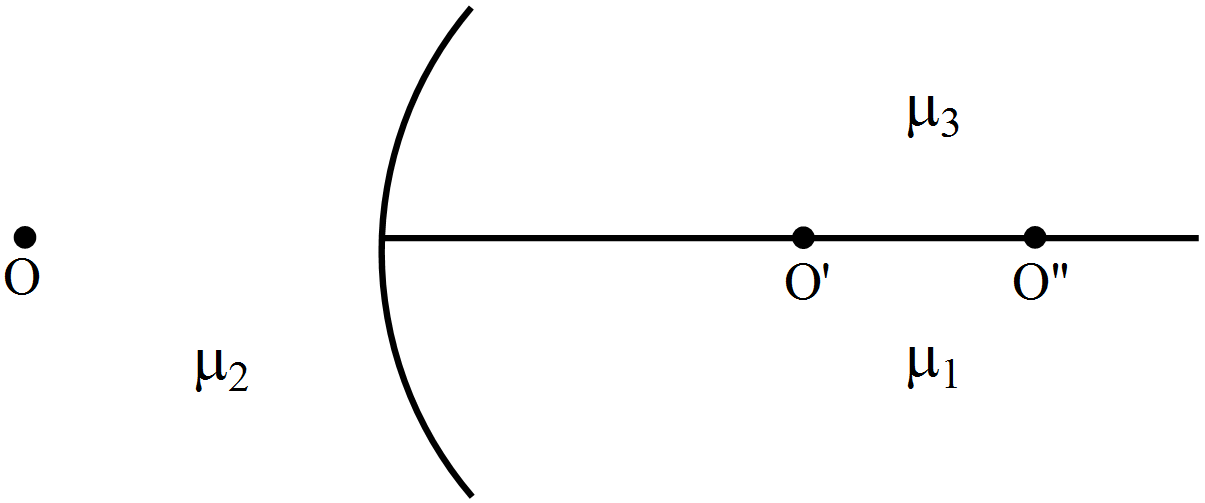
Three transparent media of refractive indices $\mu_1,\mu_2$ and $\mu_3.$ A point object $O$ is placed in the medium $\mu_2.$ If the entire medium on the right of the spherical surface has refractive index $\mu_1,$ the image forms at $O'$. If this entire medium has refractive index $\mu_3,$ the image forms at $O"$. In the situation shown:

Energy conversion in a photoelectric cell takes place from
$..........$ happens when a wave passes from one medium to another at an angle.
A man standing in a swimming pool looks at a stone lying at the bottom. The depth of the swimming pool is h. At what distance from the surface of water is the image of the stone formed (Line of vision is normal; Refractive index of water is n)
A galvanometer gives full scale deflection with $0.006$ A current. By connecting it to a $4990 \ \Omega$ resistance, it can be converted into a voltmeter of range $0-30 \ V$. If connected to a $\frac{2 n }{249} \Omega$ resistance, it becomes an ammeter of range $0-1.5 \ A$. The value of $n$ is:
A thin spherical conducting shell of radius $R$ has a charge $q$. Another charge $Q$ is placed at the centre of the shell. The electrostatic potential at a point $p$ at distance $\frac{R}{2}$ from the centre of the shell is
A transformer with efficiency 80% works at 4 kW and 100 V. If the secondary voltage is 200 V, then the primary and secondary currents are respectively