MCQ
An electron beam is moving between two parallel plates having electric field $1.125 \times 10^{-6} \mathrm{~N} / \mathrm{m}$. A magnetic field $3 \times 10^{-10} \mathrm{~T}$ is also applied so that beam of electrons do not deflect. The velocity of the electron is
  • A
    4225 m/s
  • 3750 m/s
  • C
    2750 m/s
  • D
    3200 m/s

Answer

Correct option: B.
3750 m/s
(b) 3750 m/s

Need a full question paper?

Generate a complete, print-ready paper with questions like this in minutes — across 16+ boards, with answer keys.

Start Generating Free

Similar questions

Pick out the application of potentiometer from the following.
In which of the following series, does the $121.5\ nm$ line of the spectrum of the hydrogen atom lie?
When an electric field is applied across a semiconductor:
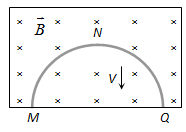
A thin semicircular conducting ring of radius R is falling with its plane vertical in a horizontal magnetic induction B. At the position MNQ, the speed of the ring is V and the potential difference developed across the ring is
Which of the following is $\text{NOT}$ a postulate of Bohr's model of the hydrogen atom?
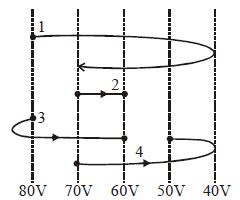
The figure shows a family of parallel equipotential surfaces and four paths along which an electron is made to move from one surface to another as shown in the figur
$(I)$ What is the direction of the electric field ?
$(II)$ Rank the paths according to magnitude of work done, greatest first
A real object approa ches a fixed diverging lens with a constant velocity from infinity along the principal axis. The relative velocity between object and its image will be
The radius of fifth orbit of the $L ^{++}$is $.........\times 10^{-12}\,m$. Take : radius of hydrogen atom $=0.51 \mathring A$
An achromatic convergent lens of focal length $20\,cms$ is made of two lenses (in contact) of materials having dispersive powers in the ratio of $1 : 2$ and having focal lengths $f_1$ and $f_2$. Which of the following is true ?
A $16\  \Omega$ wire is bend to form a square loop. A $9 \mathrm{~V}$ battery with internal resistance $1\  \Omega$ is connected across one of its sides. If a $4\  \mu \mathrm{F}$ capacitor is connected across one of its diagonals, the energy stored by the capacitor will be $\frac{x}{2} \ \mu \mathrm{J}$. where $x=$________.