Question
An electron in the hydrogen atom initially in the fourth excited state makes a transition to $\mathrm{n}^{\text {th }}$ energy state by emitting a photon of energy 2.86 eV . The integer value of $n$ will be __________ .

Answer

2
$E=13.6\left(\frac{1}{\mathrm{n}_{1}^{2}}-\frac{1}{\mathrm{n}_{1}^{2}}\right)$
$2.86=13.6\left(\frac{1}{\mathrm{n}^{2}}-\frac{1}{5^{2}}\right)$
$\frac{1}{\mathrm{n}^{2}}=0.21+\frac{1}{2.5}$
$\mathrm{n}^{2}=4$
$\mathrm{n}=2$

Need a full question paper?

Generate a complete, print-ready paper with questions like this in minutes — across 16+ boards, with answer keys.
Start Generating Free

Similar questions

A ball of mass $200\,g$ rests on a vertical post of height $20\,m$. A bullet of mass $10\,g$, travelling in horizontal direction, hits the centre of the ball. After collision both travels independently. The ball hits the ground at a distance $30\,m$ and the bullet at a distance of $120\,m$ from the foot of the post. The value of initial velocity of the bullet will be $............m/s$ (if $\left.g =10 m / s ^2\right)$
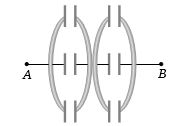
All six capacitors shown are identical, Each can withstand maximum $200\, volts$ between its terminals. The maximum voltage that can be safely applied between $A$ and $B$ is.....$V$
In a Young's double slit experiment, the slits are separated by $0.3\, {mm}$ and the screen is $1.5\, {m}$ away from the plane of slits. Distance between fourth bright fringes on both sides of central bright is $2.4\, {cm}$. The frequency of light used is $..........\,\times 10^{14} {Hz}$
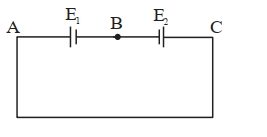
Two cells are connected in opposition as shown. Cell $\mathrm{E}_1$ is of $8 \mathrm{~V}$ emf and $2 \ \Omega$ internal resistance; the cell $E_2$ is of $2 \mathrm{~V}$ emf and $4\  \Omega$ internal resistance. The terminal potential difference of cell $\mathrm{E}_2$ is:
A wheel of mass $10\, kg$ has a moment of inertia of $160\, kg-m^2$ about its own axis, the radius of gyration will be ....... $m$
A rod of mass $M$ and length $L$ is lying on a horizontal frictionless surface. A particle of mass ' $m$ ' travelling along the surface hits at one end of the rod with velocity $'u'$ in a direction perpendicular to the rod. The collision is completely elastic. After collision, particle comes to rest. The ratio of masses $\left(\frac{m}{M}\right)$ is $\frac{1}{x}$. The value of ' $x$ ' will be ..... .
A positive ion A and a negative ion B has charges $6.67 \times 10^{-19} C$ and $9.6 \times 10^{-10} C$, and masses $19.2 \times 10^{-27} kg$ and $9 \times 10^{-27} kg$ respectively. At an instant, the ions are separated by a certain distance r. At that instant the ratio of the magnitudes of electrostatic force to gravitational force is $P \times 10^{-13}$, where the value of $P$ is __________ .
(Take $\frac{1}{4 \pi \varepsilon_0}=9 \times 10^9 Nm ^2 C ^{-1}$ and universal gravitational constant as $6.67 \times 10^{-11} Nm ^2 kg^{-2}$ )
The diameter of aperture of a plano-convex lens is $6 \,cm$ and its maximum thickness is $3 \,mm$. If the velocity of light in the material of the lens is $2 \times 10^8 \,m / s$, its focal length is ........ $cm$
The position vector of a particle changes with time according to the relation $\vec r\left( t \right) = 15{t^2}\hat i + \left( {4 - 20{t^2}} \right)\hat j$. What is the magnitude of the acceleration at $t = 1$ ?
$A$ certain prism is found to produce a minimum deviation of $38^o$. It produces a deviation of $44^o$ when the angle of incidence is either $42^o$ or $62^o$. What is the angle of incidencewhen it is undergoing minimum deviation?......$^o$