- A$\frac{{Bv_0^2}}{E}$
- B$\frac{B}{E}$
- C$\frac{{E{v_0}}}{B}$
- ✓$\frac{{B{v_0}}}{E}$
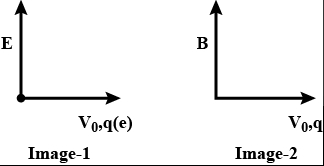
Refer image $1.$
$q \rightarrow$ change of electron.
Four due to electric field $=q E$
$\therefore \frac{m v_{0} {^2}}{R_{e}}=q E$
where $R_{e}$ is radius of curvature,
$\therefore \frac{1}{R_{e}}=\frac{q E}{m v_{0} {^{2}}}$
$\therefore=\frac{m v_{0} {^{2}}}{q E}=r_{1}$
In magnetic field,
Focus on electron $=q V_{0} B$
Refer image $2 .$
Balancing of centripetal and centrifugal focuses,
$\frac{m V_{0} {^{2}}}{R b}=q V_{0} B$
$\therefore R_{b}=\frac{m V_{0}}{q B}=r_{2}$
$\therefore \frac{r_{1}}{r_{2}}=\frac{R_{c}}{R_{b}}=\frac{\frac{m V_{0^{2}}}{q E}}{\frac{m V_{0}}{q B}}$
$\therefore \frac{r_{1}}{r_{2}}=\frac{B V_{0}}{E}$
Generate a complete, print-ready paper with questions like this in minutes — across 16+ boards, with answer keys.


Statement $I:$ Biot-Savart's law gives us the expression for the magnetic field strength of an infinitesimal current element (IdI) of a current carrying conductor only.
Statement $II :$ Biot-Savart's law is analogous to Coulomb's inverse square law of charge $q$, with the former being related to the field produced by a scalar source, Idl while the latter being produced by a vector source, $q$. In light of above statements choose the most appropriate answer from the options given below: